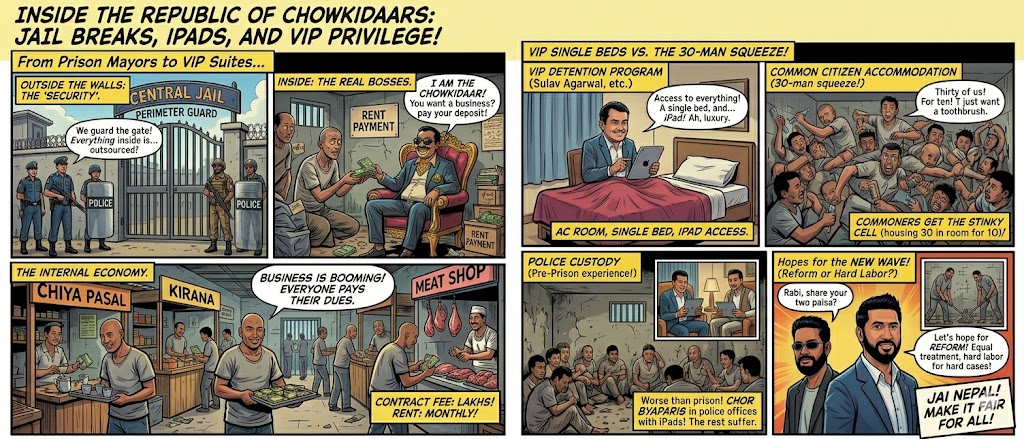
Our dearest baini recently pulled off a cinematic escape from Central Jail, only to return within twenty-four hours to resume her life sentence. While the media panicked over "security breaches," the real revelation was a reminder of who actually runs the joint. In Nepal, we don't bother with conventional corrections. We practice administrative outsourcing. The police and Armed Police Force (APF) wallahs guard the exterior perimeter like eager bouncers at an exclusive club, while the inmates run the entire show inside.
Welcome to the prison Republic of Nepal, where the prison has its own "Mayor"—the Chowkidaar—complete with naikeys and bhai naikeys managing a thriving internal economy. Forget rehabilitation; we have prime real estate. Inside, you will find bustling chiya pasals, canteens, grocery stores, and even a meat shop.
Getting a contract to chop onions or sell biscuits costs lakhs of Rupees in under-the-table deposits, with hefty monthly rents flowing straight to the inmate hierarchy and their hakim best friends at the Home Ministry. Meanwhile, ordinary inmates receive a government stipend just about enough to afford a toothbrush and a tube of toothpaste, unless their wives or mistresses bail them out with extra pocket money.
VIP Single Beds vs. The Thirty-Man Squeeze
The housing market inside is equally legendary. If you are a high-profile neta, a former IGP, or a Deepak Manangey, you get a cozy single bed. If you are a regular citizen, you get packed into a room with thirty other souls in a space built for ten. It is a masterclass in extreme hospitality.
Our legendary old-school politicians spent years in these cells. Even Rabi Lamichhane had his own stint in custody. Yet, despite their rich historical background, none of them has thought to share their prison memoirs or propose a humane system where inmates can live with actual dignity.
Enter the Angry Egghead
Instead of letting 99% of inmates suffer from mental anxiety, loneliness, and extortion, why not make them productive? We could appoint Harka Sampang, our perpetually angry egghead, as the Prison Department Head. Let him and his crew make hard-core inmates sweat for national development. We could open printing presses for our millions of offline Nepali calendars, launch pickle factories, or manufacture cake packaging.
-
VIP & Neta Status: Enjoy single beds, private officer quarters, AC rooms, and iPad access.
-
Common Citizen Status: Enjoy sharing a 10-person room with 30 new best friends.
The Luxury Detention Program
But wait, the pre-prison experience in our local police custody cells is even more thrilling. A single cell houses a dozen people with a stinky hole for a bathroom. Where are our Human Rights wallahs? Enjoying their air-conditioned offices, of course, since they have never spent a night breathing in custody fumes.
Unless, of course, you are a chor byapari like Deepak Bhatta or Sulav Agarwal, currently under investigation for a casual Rs 20 billion insider trading scandal. For them, custody means relaxing in senior police officers' private rooms at the Lalitpur District Police Office, complete with iPads and high-speed internet.
When the media ruined the fun, our bhai Sulav—the pandemic hero who sold Rs 3,000 Chinese thermal guns for Rs 15,000—instantly developed "health issues" and checked into a luxury hospital cabin.
The SSP of Lalitpur needs to face the music, and our cops need to realize a new wave has arrived. We can only hope the Balen-led political wave sweeps away this centuries-old chowkidaari racket. Let Rabi Lamichhane head a Prison Reform Taskforce to ensure that if wealthy thieves must go to jail, they share the same stinky 6x4 cell and free sinus infections as the local pickpockets. Let's make justice equal, fair, and delightfully uncomfortable for everyone.
Jai Nepal!