It is officially the diamond jubilee of our relationship with the Asian Development Bank (ADB)! To celebrate six decades of Nepal enthusiastically signing up for debt, ADB President Masato Kanda touched down in Kathmandu. He immediately sat down with Prime Minister Balendra (Balen) Shah to discuss "deepening bilateral cooperation," economic transformation, and job creation. Kanda noted that Nepal is at a "crucial turning point" with a massive opportunity to build a resilient economy.
We love a good turning point; we’ve been turning points for thirty years, and frankly, we are getting a bit dizzy. Still, Kanda optimistically promised that ADB will ramp up its support to a staggering $2.4 billion by 2029, with a laser focus on results and employment. We’ll believe the jobs when our youth stop filling out passport applications at midnight.
The Fresh Cash: Drinking Water and Digitizing Our Historic Lineups
During the visit, Kanda didn't just bring compliments—he brought the checkbook. ADB signed off on two major loan agreements totaling $165 million. First up is an $115 million water project aimed at giving 850,000 citizens clean, reliable drinking water. (Melamchi, please don’t look at this paragraph, it’s sensitive).
The second is a $50 million policy loan to modernize and digitalize our cross-border goods transport system. This is designed to cut costs and increase efficiency for businesses, which is an incredibly hopeful way of saying "maybe our truck drivers won't have to wait in a three-day queue just to get a stamp from a guy using a desktop computer from 2004."
The Field Trip: Virtual Ribbons and AI-Powered Classrooms
President Kanda then went on a whirlwind tour to see what past ADB money actually bought. Alongside Energy Minister Biraj Bhakta Shrestha and the Norwegian Ambassador, he virtually inaugurated two power substations built to strengthen Kathmandu’s erratic electricity supply. Next, he zipped over with Education Minister Sasmit Pokharel to visit a school rebuilt after the 2015 earthquake.
The school is now equipped with modern science facilities and—wait for it—an artificial intelligence (AI) learning pilot project to teach students market-ready skills. It’s comforting to know that while our physical roads still look like the surface of Mars, our kids will at least be able to use ChatGPT to write essays about why the bus was four hours late.
The Closed-Door Confessionals: Swarnim Wagle and Private Sector Tears
No donor visit is complete without a chat with the money man. Finance Minister Swarnim Wagle met with Kanda to dive deep into economic reform agendas, business environments, and investment mobilization. Kanda also rounded up Nepal’s top private-sector leaders to discuss investment hurdles and job creation.
Under the ADB’s new Partnership Strategy (2025–2029), they plan to pump up annual lending to $660 million this year, focusing on green infrastructure, digital transformation, and innovative financial tools like "local currency bonds." The private sector likely wept tears of joy, or anxiety—it’s hard to tell the difference these days when looking at our interest rates.
The Three-Decade Reality Check: How We Managed to Spend Billions and Stay Poor
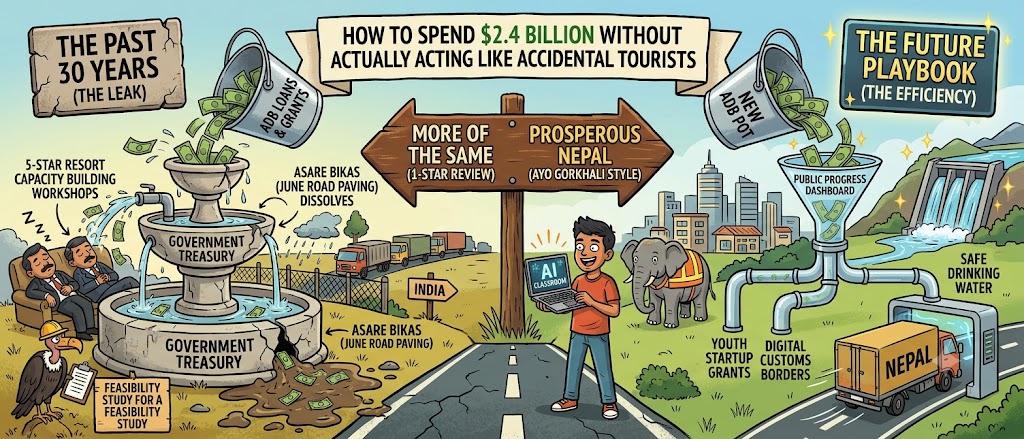
Let’s take a quick, sarcastic stroll down memory lane. For the past thirty years, various iterations of our revolving-door governments have treated international loans and grants like a lottery win rather than a sacred trust. We’ve seen billions poured into "feasibility studies" that resulted in nothing but fat binders collecting dust in Singha Durbar.
Past administrations mastered the art of capital under-spending, where we somehow managed to return unused development funds at the end of the fiscal year while our national highways remained deadly obstacle courses. Corruption, bureaucratic red tape, and political infighting turned massive grants into petty cash for administrative overhead. If past government performance were an Uber driver, we would have given them a 1-star review and demanded a refund three decades ago.
The Ayo Gorkhali Playbook: Turning Free Cash Into a Prosperous Nepal
But hey, we are the land of eternal optimism! If we want to actually build a prosperous Nepal, we need to completely overhaul how we utilize this $2.4 billion ADB pot. First, we must end the "Asare Bikas" phenomenon—the hilarious national tradition of paving roads in June just in time for the monsoon rains to wash them away. Second, every single dollar of policy loans must be tied strictly to digital transparency; let’s track the money on a public dashboard so we know exactly which contractor bought a new SUV instead of buying pipes.
Finally, let’s stop using grants for endless "capacity-building workshops" at five-star resorts and put that money directly into local currency bonds to fund youth-led startups and green energy. We have the brains, we now have the AI classrooms, and we definitely have the ADB’s money. All we need to do is stop acting like accidental tourists in our own development plan and finally build the nation we deserve.
Jai Nepal!