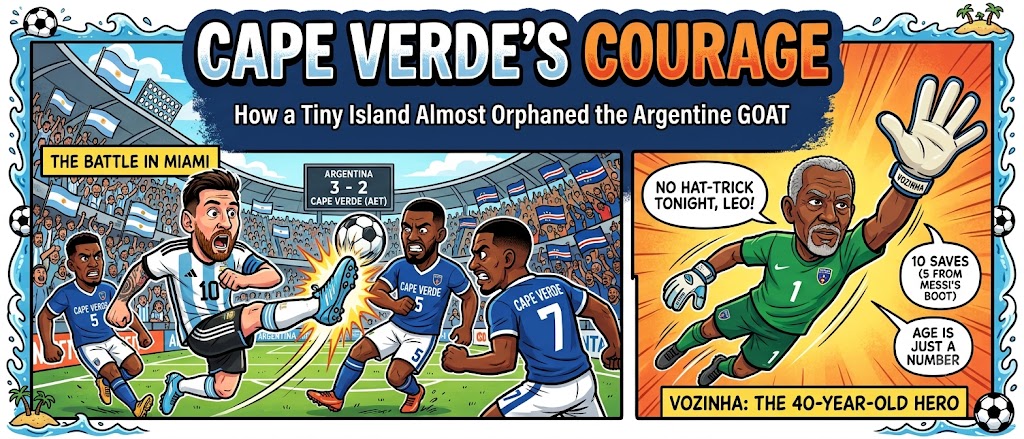
Let’s be honest: when the FIFA World Cup 2026 Round of 32 draw paired the defending world champions, Argentina, with Cape Verde, the only real question was whether Lionel Messi would score a hat-trick before or after halftime. Cape Verde—a tiny island nation with a population smaller than Kathmandu’s traffic jams—was supposed to be a polite footnote in Argentina's inevitable march to glory.
Instead, the Blue Sharks decided to turn the Miami Stadium into a psychological thriller. Lionel Messi opened the scoring in the 29th minute, a moment where the universe seemed to reset to its default settings. But instead of folding like a cheap tent, Cape Verde responded by playing like men possessed.
When Deroy Duarte equalized in the 59th minute, the pro-Argentine crowd didn't just go quiet; they collectively began questioning their life choices. Even when Lisandro Martínez restored Argentina’s lead in extra time, Sidny Lopes Cabral unleashed a 103rd-minute curling masterpiece to make it 2-2, reminding the world that David still knows how to throw a rock.
Vozinha: The 40-Year-Old Who Decided To Ruin Messi’s Evening
If you ever feel too old to chase your dreams, consider Cape Verde's goalkeeper, Vozinha. At 40 years old—an age where most mortals are complaining about lower back pain—Vozinha stood between the sticks and looked Lionel Messi dead in the eye. He didn’t just play; he put on a masterclass in goal-tending heroism, racking up 10 saves, five of which came directly from the left boot of the greatest player to ever walk the earth. Messi's legendary free-kicks were swallowed up like casual practice passes.
For a few glorious, agonizing hours, it felt like Vozinha possessed the mystical power to freeze time, or at least freeze the reigning world champions. It took an incredibly cruel, 111th-minute deflected own-goal by his own defender, Diney Borges, to finally break his resistance and gift Argentina a victory. Argentina won the match, but Vozinha won early retirement respect across the globe.
Dear Nepal: You Can Actually Qualify If You Stop Running Away From the Ball
Now, let us turn our eyes to the rooftop of the world, where the All Nepal Football Association (ANFA) watches from afar. Nepal has a population of over 30 million people and a mountain range that protects us from everything except our own sports bureaucracy. Cape Verde has under 600,000 people and is surrounded by water, meaning they have fewer people to pick a squad from than Nepal has registered motorcycle drivers. The ultimate lesson here is simple yet profoundly painful: size doesn't matter if you have structure, discipline, and a complete lack of fear.
Cape Verde didn’t qualify for their first-ever World Cup knockout rounds by praying for a miracle; they did it by holding former champions Spain and Uruguay to tactical draws. If a tiny cluster of volcanic islands can push Lionel Messi to the absolute brink of elimination in extra time, Nepal can at least dream of making it to the Asian Cup without requiring a mathematical calculator and seven favorable acts of God.
For a country like Nepal, Cape Verde’s success isn't just an entertaining sports story; it is a literal blueprint. Nepal often faces similar structural hurdles—limited infrastructure, a smaller footprint in the global football landscape, and the daunting task of competing against regional giants.
Cape Verde proved that you don't need a population of 100 million to build a world-class competitive squad. They maximized what they had by focusing on three core pillars:
-
A Unified Defensive Identity: They didn't try to out-talent opponents; they out-worked them, building an incredibly disciplined defensive shape that frustrated top-tier attackers.
-
Leveraging the Diaspora: Cape Verde aggressively scouted and integrated eligible players across European leagues, instantly elevating the technical ceiling of their domestic squad.
-
Fearless Psychology: They played without the burden of fear, treating matches against giants not as a damage-control exercise, but as an opportunity for immortality.
If the youth systems and national selectors in Nepal can adopt even a fraction of this structured, fearless approach, the gap between regional competitiveness and the global stage will start to close much faster than anyone thinks. Cape Verde showed the world that courage doesn't roar; sometimes, it just stands its ground and keeps a clean sheet.
Jai Nepal!