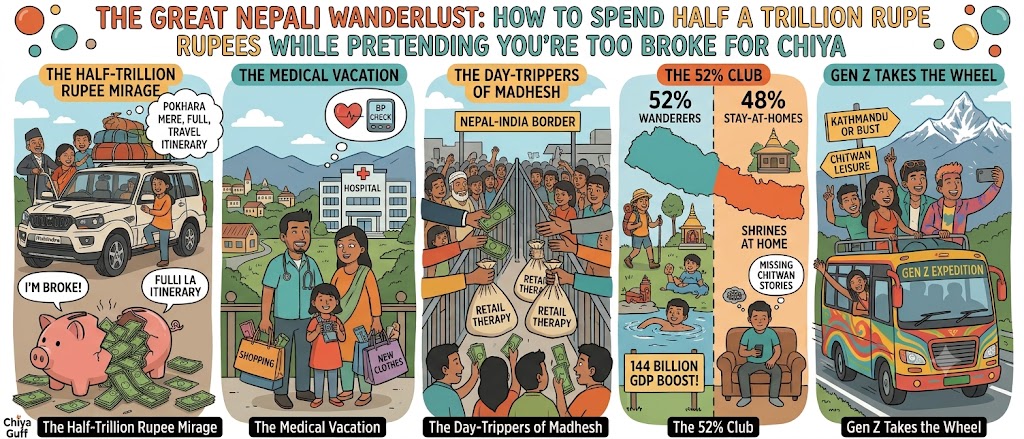
According to the National Statistics Office's ground-breaking Internal Tourism Survey, Nepalis spent a mind-boggling 459 billion rupees on travel in a single year. Let that sink in. We consistently complain that the economy is collapsing, yet we collectively dropped enough cash on holidays to fund a small space program. Domestic overnight trips swallowed 304 billion rupees, while single-day escapes drained another 91 billion rupees.
The dark comedy here is spectacular: our national pastime is claiming we have no money while simultaneously booking a Scorpio to Pokhara. Yet, there is a beautiful, hopeful truth underneath the math. Despite structural stagnation, the Nepali spirit refuses to be confined to a corner. We breathe life right back into our own economy, one mountain highway at a time.
The Medical Vacation: Packing Extra Ibuprofen for the Road
In a deeply ironic twist of data, the single largest expense category for domestic travel wasn't paragliding or luxury resorts—it was medical treatment, capturing 31.78% of the total budget. Yes, the ultimate Nepali holiday involves travelling across provinces to see a better doctor. To make it a true vacation, shopping came in at a close second at 26%, meaning we are simultaneously buying new clothes and getting our blood pressure checked.
Public buses remain the majestic chariot of choice for these hybrid medical-retail pilgrimages. It’s dark, sure, but it showcases our endless adaptability: turning a hospital visit into a family road trip because if you don't laugh through the systemic gaps, you’ll cry.
The Day-Trippers of Madhesh: Surviving India via Retail Therapy
The survey notes that around 300,000 Nepalis ventured abroad, with a massive chunk pulling off the ultimate "day-trip" stunt. Nearly 293,000 crossed borders and returned the exact same day, heavily concentrated in Madhesh Province, where crossing into India for cross-border shopping is practically a competitive sport.
In fact, 70% of the money spent on these same-day Indian excursions went entirely to shopping. For those pulling overnight international trips, 40% went for shopping and 19.6% went for religious pilgrimages—because nothing balances out the sin of aggressive consumerism quite like praying for forgiveness at a holy shrine immediately afterward.
The 52% Club: Half the Country is Missing from Home
A staggering 52.4% of Nepali households participated in at least one tourism activity during the year, meaning over half the country was effectively away from their living rooms. Meanwhile, the remaining 47.6% stayed home, presumably watching the other half post Facebook stories from Chitwan.
The average travelling family size sits at nearly 4 people, rising to almost 5 in rural areas. Internal tourism managed to inject 144 billion rupees straight into Nepal's GDP, proving that local travelers are keeping the country afloat far better than any international aid package ever could.
Gen Z Takes the Wheel: The Youth Will Save the Hotels
Who is doing all this traveling? Generation Z (ages 13–28) is leading the pack, making up 26.6% of the travel demographic, followed closely by Gen Alpha/Beta and Millennials. They are flocking to Kathmandu, Chitwan, and Kaski, with Kaski—naturally—reigning supreme for pure leisure and vacationing.
Business travelers are the most hyperactive, traveling 6.9 times a year, while the average leisure traveler manages 3 trips. Ultimately, this survey proves that whether we are traveling 8 days in Sudurpashchim for "education" or dodging relatives in Gandaki 6 times a year, the Nepali urge to wander is unbreakable. We travel to heal, we travel to buy, and most importantly, we travel because we refuse to stand still.
Jai Nepal!