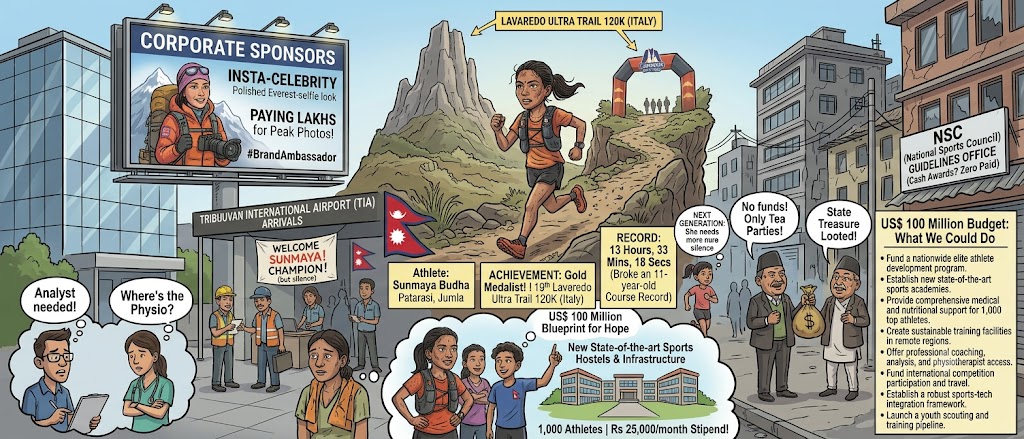
On June 27, 2026, Sunmaya Budha did something entirely inconvenient for the Nepali sports establishment: she won. She didn’t just survive the grueling, bone-crushing 120-kilometer Lavaredo Ultra Trail in Italy; she absolutely shattered it. Conquering 5,800 meters of vertical elevation, she crossed the finish line in 13 hours, 33 minutes, and 18 seconds—mercilessly shaving more than six minutes off a course record that had stubbornly stood for 11 years. She left world-class elite runners like Australia’s Lucy Bartholomew choking on her dust during the final downhills.
Flash forward three days later to Tribhuvan International Airport. Was there a roaring crowd? A red carpet? A line of politicians pushing past each other to get a shameless selfie for their social media pages? Absolutely not. Instead, one of the greatest trail runners on the planet walked into a wall of silence, greeted only by her manager Preeti Khatri, a lonely banner, and a handful of well-wishers. Sunmaya wasn’t even surprised; she intentionally hides her arrival details because she knows the state's enthusiasm for actual talent is profoundly nonexistent.
The Everest PR Circus vs. Real Heroes
Let’s look at our brilliant corporate sponsors. They will happily dump tens of lakhs of rupees on Instagram-famous women celebrities to climb Mount Everest for the aesthetic, the lifestyle brand collaborations, and the ultimate peak-side photoshoot. Yet, when it comes to supporting our real women heroes—the gritty, elite athletes making our country proud on the global stage—these brands suddenly go legally blind and financially paralyzed.
True champions like Sunmaya are forced to aggressively hunt for their own international sponsorships just to secure a basic professional ecosystem. They have to stress over their daily diets, training gear, and literally hustle to survive the brutal rental market of Kathmandu. If your sport doesn’t come with a viral hashtag or a heavily filtered mountain sunrise, corporate Nepal doesn't know you exist.
We cannot entirely blame the government, though. To be fair, the government is completely broke. The state treasury has been thoroughly looted by our old-school netas and their fiercely loyal, flag-waving jholeys. Meanwhile, the bureaucracy operates like a beautifully synchronized extortion racket on its citizens, leaving less than pocket change for sports development.
The National Sports Council has beautiful guidelines promising cash rewards, but our world-conquering trail runners haven't seen a single paisa. The state has no money for running shoes because it is all being spent on VIP fuel allowances and political tea parties.
The US$ 100 Million Blueprint for Hope
But Ayo Gorkhali is not a cry of despair; it is a declaration of defiance. We can change this narrative with genuine optimism and a bold US$ 100 million national sports budget, four times more than what the government spends currently. Let us bypass the corrupt gatekeepers and invest directly in 1,000 of our young, raw talents across every single discipline—be it trail running, football, cricket, basketball, volleyball, chess, or tennis.
By paying them a basic monthly stipend of at least Rs 25,000, we ensure they don't starve. That costs less than 300 million rupees annually. The remaining funds can be systematically utilized every year to construct state-of-the-art sports infrastructure, dedicated athlete hostels, free structured meal plans, and top-tier training materials.
Imagine our youth from the remote ridges of Jumla to the plains of Jhapa training under professional coaches, physiotherapists, and sports analysts. Sunmaya fights on so that her youngest sister, Rammaya, and the next generation of Nepali athletes will never have to return home to total silence. It’s time to stop cheering for the thieves and start investing in our champions.
Jai Nepal!