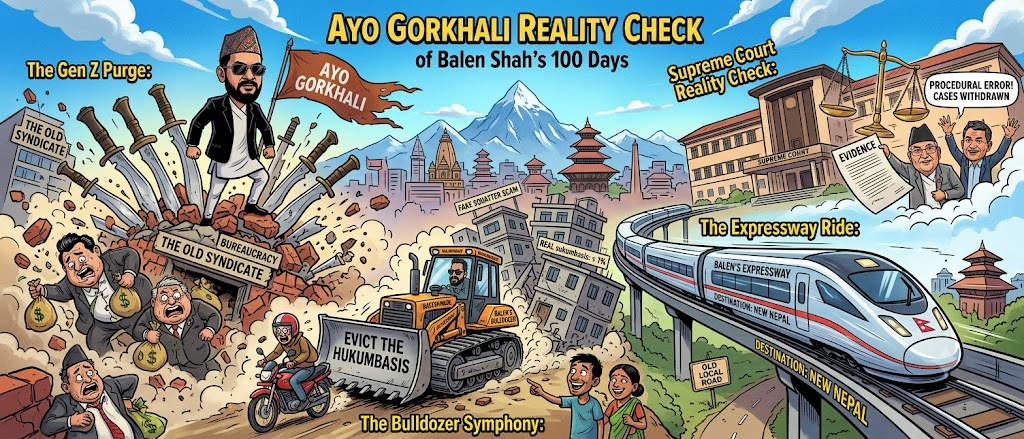
A hundred days ago, the dusty corridors of Singha Durbar experienced a terrifying anomaly: the smell of fear. The traditional political syndicates, who had spent decades treating Nepal’s treasury like a personal inheritance, suddenly found themselves staring down the barrel of a Gen Z revolution. Armed with millions of popular votes and 182 seats, Prime Minister Balendra (Balen) Shah marched into office like a true Gorkhali warrior ready to hack corruption at its very roots.
On Day One, he unrolled a majestic 100-point governance blueprint. The old guard thought it was just a flashy PowerPoint presentation; Balen treated it like a tactical battle plan. The message was loud, clear, and gloriously aggressive: Ayo Gorkhali! The corruption cleansing had begun, and nobody was invited to a compromise tea party.
The Nostalgic Dinosaurs and Their 10% Report Cards
The sheer irony of the opposition’s sudden passion for good governance deserves a standing ovation. The Nepali Congress hastily formed a "special task force" to grade the government, generously awarding them a 30%. Not to be outdone in the comedy department, UML’s Ain Mahar slapped a brutal 10% mark on the desk, weeping that "democracy is in a coma."
"Inflation is rising, and the government is walking upside down on its head!" Mahar cried out.
It is a genuinely beautiful, dark comedy to watch these political relics—who successfully engineered the country's economic stagnation for thirty years—suddenly morph into strict, rule-abiding school principals. They are deeply offended that the new kid in school isn't playing by their corrupt rulebook.
The Great Bulldozer Symphony: Evicting the Hukumbasis
Of course, our young revolutionary government isn't without its special brand of chaos, especially when the heavy machinery rolls into the riverbanks. The opposition shed massive crocodile tears over the clearing of the Bagmati settlements, screaming about the plight of the "landless." But let's be honest enough to look past the political theater.
Real, genuine sukumbasis (the truly landless) don't even make up 1% of that crowd. The rest? A thriving empire of hukumbasis—fake squatters who own multi-story concrete houses elsewhere, driving nice motorbikes, but occupying prime riverside public land just because a political party promised them land titles in exchange for votes.
Balen’s bulldozers didn't destroy lives; they destroyed a lucrative, politically protected real estate scam. While the opposition whines about "human rights" to protect their vote banks, the rest of Kathmandu is quietly celebrating that someone finally had the guts to reclaim public riversides from these wealthy "impoverished" landlords.
Expressways, Border Blunders, and Extreme Off-Roading
In a moment of supreme diplomatic freestyle that left everyone blinking, PM Balen casually announced to parliament that Nepal had encroached upon India's border. The entire foreign ministry collectively choked on their water. But before anyone could panic, the government shifted focus back to its favorite therapeutic tool: high-speed urban development.
When the opposition rightfully screamed about political and diplomatic maturity, the Prime Minister delivered a masterclass in Gorkhali swagger. He told everyone that our vehicle is not on some muddy village trail; it’s on a high-speed expressway, and brakes are only applied when we reach the destination. It is a spectacularly bold metaphor. Let’s just pray our expressway doesn’t end in a dramatic, un-braked leap into a gorge.
The Supreme Court System vs. Pure Gorkhali Ambition
You have to admire the raw audacity of Balen’s anti-corruption crusade. Right out of the gate, the government did the unthinkable: they actually arrested political untouchables like KP Oli and Ramesh Lekhak for suppressing the youth movement. For twenty-four glorious hours, the public celebrated. Finally, the giants were falling!
Then, reality walked in. The Supreme Court ordered their release faster than you can say "procedural error," citing a tragic lack of actual evidence. Next up, arrest warrants for money laundering were issued for Sher Bahadur Deuba and Arzu Rana. Once again, the judicial system hit the pause button. Meanwhile, organized crime cases against the government’s own friends magically vanished. It turns out, uprooting a system of institutionalized bribery requires a bit more than just a sharp khukuri and good intentions; you actually need a legal team that knows how to file paperwork properly.
The Unstoppable Gorkhali Spirit: Why We Will Win Anyway
Despite the magnificent, headline-grabbing chaos of the last hundred days, it is impossible to ignore the bright, blinding light of optimism here. For the first time in modern history, the corrupt elite are genuinely terrified. They aren't laughing anymore; they are panicking. By targeting fake hukumbasi networks and entrenched politicians, Balen has fundamentally broken the old political monopoly. The youth aren't just voting; they are watching every single line item in the budget.
RSP Chairman Rabi Lamichhane proudly declared that the ball is firmly at Balen’s feet to score the final goal for Nepal's future. We Gorkhalis have survived earthquakes, crippling blockades, and decades of absolute political incompetence. If we can survive the old syndicate, we can certainly survive a few dents on Balen's expressway. The drivers are wildly inexperienced, the navigation system is broken, but the engine of change is roaring. Keep your heads high, stay sharp, and don't look back—the revolution is just getting started.