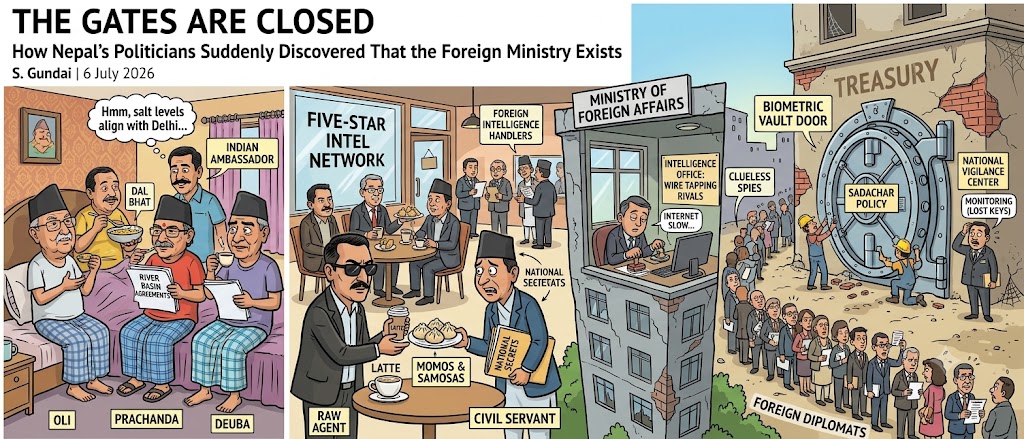
For decades, the holy trinity of Nepali politics—Oli, Prachanda, and Deuba—practiced a highly intimate form of international relations. Forget embassy halls or official state dining rooms; the real geopolitical heavy lifting happened right in their bedrooms, often while wearing comfortable lungis. The Indian Ambassador didn't just have a pass to the government secretariat; he had a free pass straight into the kitchen, probably tasting the dal bhat to ensure the salt levels aligned with Delhi's regional strategic interests.
While our top leaders were whispering sweet nothings and signing away river basins over late-night tea in their private quarters, the actual Ministry of Foreign Affairs was left doing what it does best: stamping passports and wondering why the internet in the office was so slow.
The Five-Star Coffee Shop Intel Network
Meanwhile, in the plush, air-conditioned lounges of Kathmandu’s five-star hotels, a completely different kind of administrative summit was taking place. RAW agents and foreign intelligence handlers routinely booked corner tables, casually sipping lattes with high-ranking Nepali bureaucrats. Our brilliant civil servants were happily trading core national secrets, sensitive border maps, and internal policy drafts for the low, low price of Chiya Kharcha (tea money) or the vague promise of a fully funded master's degree for their son in Delhi or Sydney.
The joke, of course, was on the foreign spies. They spent millions of rupees on black ops and surveillance, completely unaware that a couple of samosas and a plate of momos at the Hyatt lounge would unlock the entire state apparatus.
Clueless Spies and Blind Watchdogs
While our state secrets were being distributed like free flyers at a tourist hub, Nepal’s own intelligence apparatus and formal diplomatic corps remained blissfully, beautifully ignorant. Our intelligence officers were far too busy wiretapping rival political factions or tracking which local youth leader said what on Facebook to notice that the country's sovereignty was being bartered away over macchiatos. If you asked a Foreign Ministry official about a secret bilateral understanding back then, they’d look at you with wide, innocent eyes and ask if it was happening on a Zoom call they forgot the password to.
Enter the 'Sadachar' Policy: Locking an Empty Vault
But fear not, citizens! The dark ages of casual espionage are over. The Cabinet has officially passed the "Integrity Policy." From now on, if a politician wants to talk to a foreigner, they must formally ask the Foreign Ministry for permission. It is a masterpiece of comedic timing. It’s like installing a biometric, state-of-the-art vault door on a treasury building that was completely cleaned out fifteen years ago. The National Vigilance Center has been tasked with monitoring this, which is reassuring, assuming they can find their own car keys in the morning.
The Audacity of Hope (and Local Samosas)
And yet, against all logic, there is room for profound optimism here. This policy proves that deep down, our government possesses a magnificent, almost poetic sense of hope. They genuinely believe that there are still secrets left to protect. They believe that after decades of open-door kitchen diplomacy, we can suddenly erect a digital firewall using paper files and red tape.
If nothing else, this law will finally force foreign diplomats to do what ordinary Nepalis have done for centuries: wait in a long, suffocating queue at a government office, fill out three copies of Form 10, and wait for a joint secretary to finish his lunch break. If RAW wants our secrets now, they’ll have to suffer through our bureaucracy first—and that, dear citizens, is how the Gorkhalis truly win.
Jai Nepal!