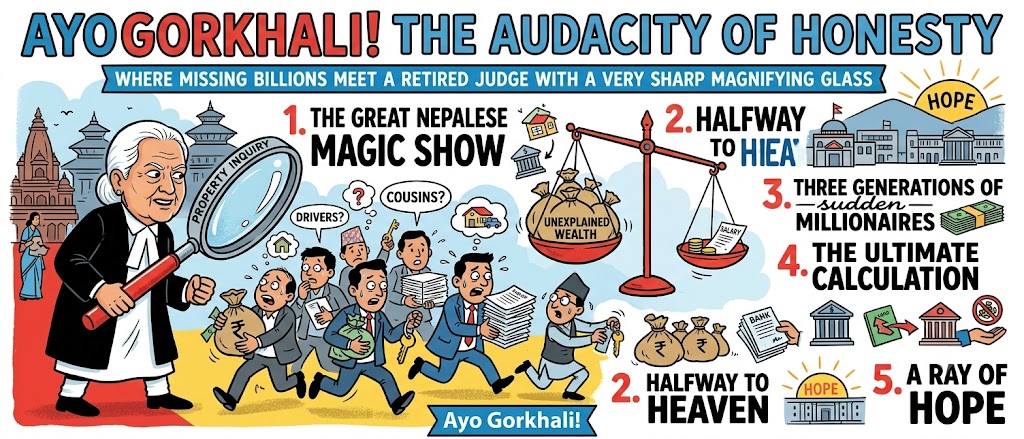
Ayo Gorkhali! Brace yourselves, citizens, because the circus has officially come to town, and this time, the clowns are wearing expensive, unexplained Italian suits. The newly minted Property Inquiry Commission, captained by the honorable former Supreme Court Justice Rajendra Kumar Bhandari, has officially begun the daunting task of peeling back the layers of Nepal’s favorite national sport: competitive asset hiding.
As of this week, a whopping 13,000 public officials have miraculously found their pens and submitted their asset declarations. Meanwhile, another 1,500 highly entertaining individual complaints have landed on the commission's desk, mostly from patriotic whistleblowers pointing out that a government peon shouldn’t technically own three shopping malls and a fleet of Land Cruisers.
Halfway to Heaven (or Just Halfway to the Deadline)
With the July 14 deadline looming over Kathmandu like a heavy monsoon cloud, only about half of the required 25,000 public officials have complied. The rest are presumably stuck in traffic, or perhaps struggling to spell the names of the distant cousins they registered their penthouses under. In a beautifully sarcastic twist of irony, a handful of retired justices have announced a grand "boycott" of the process. Because nothing says "I have absolutely nothing to hide" quite like publicly refusing to show anyone what you have hidden. Spokesperson Ganesh KC, however, remains remarkably optimistic. He reassured the public that the commission will simply play an independent game of hide-and-seek, retrieving bank and land records directly. You can run, Your Honor, but the paper trail has long legs.
Three Generations of Sudden Millionaires
The Commission’s mandate is deliciously ambitious: auditing the wealth of high-ranking bureaucrats and political titans over the last two decades. For twenty years, the formula was simple—earn a modest government salary, buy a mansion, and blame it on "ancestral poultry farming." Now, the Bhandari-led dream team—complete with retired police muscle and chartered accountants—is opening sealed envelopes at breakneck speed. They are actively hunting for assets hidden within three generations of relatives. Imagine the family drama this week across Nepal! Uncles are calling nephews, wives are questioning husbands, and office assistants are suddenly finding out they legally own millions of dollars in shares that they will never, ever see.
The Ultimate Calculation: Math vs. Myth
The second phase of this grand inquiry will do something truly revolutionary in Nepalese administrative history: basic math. The panel intends to cross-reference legitimate income—like actual salaries and modest allowances—against accumulated wealth. If the math doesn't math, the files get gift-wrapped and handed over to the Commission for the Investigation of Abuse of Authority (CIAA) for prosecution. To ensure nobody fudges the numbers, financial and banking experts are being flown in. It’s a beautifully hopeful moment for the average citizen who has spent decades wondering how a civil servant on a $400-a-month salary manages to send four kids to Ivy League schools.
A Ray of Hope in a Land of Sealed Envelopes
Despite the cynicism that usually breeds in the corridors of Singha Durbar, there is genuine hope shimmering through this bureaucratic audit. Over 100 former judges have already complied, proving that integrity isn't completely extinct. Once this current batch of twenty-year audits is complete, the commission plans to launch an even bigger sequel: investigating wealth accumulated all the way back to 1991. The message is loud, clear, and wonderfully terrifying for the corrupt. The Property Inquiry Commission may not have the power to throw anyone in jail directly, but they are turning on the lights in a very dark room—and the cockroaches are officially scrambling.
Jai Nepal!