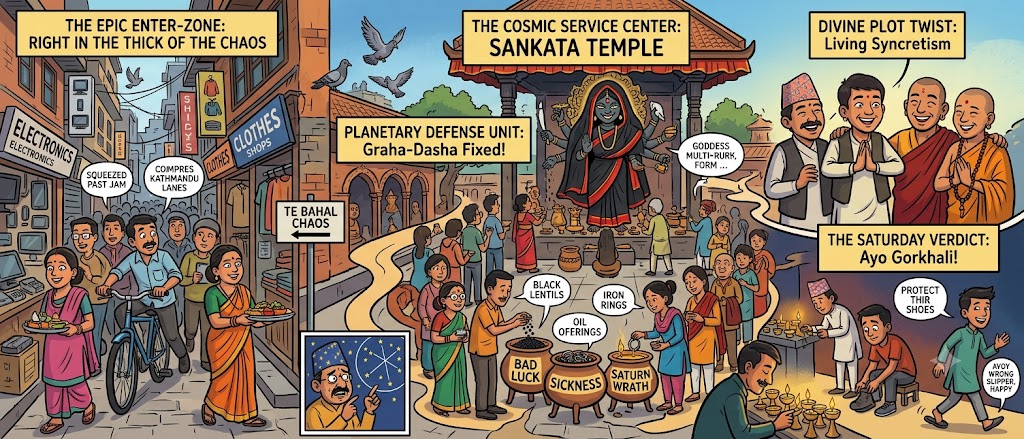
If you have ever tried navigating the narrow lanes of Te Bahal right off Kathmandu’s infamous New Road, you already know that survival is a spiritual victory in itself. Wedged neatly between a sprawling maze of electronics shops, traffic jams, and street vendors selling everything from momo to smartphone covers, sits the ancient Sankata Temple.
You don't just walk into Sankata; you squeeze your way through a heavy wall of human traffic, dodging aggressive pigeons, enthusiastic flower sellers, and a thick, aromatic fog of burning incense and oil lamps. It is the exact heart of Kathmandu: delightfully unhinged, intensely crowded, and unapologetically spiritual.
The Planetary Defense Unit: Warding Off Your Terrible Horoscopes
So, why do thousands of Nepalis descend upon this specific, tightly packed courtyard every single Saturday? Simple: Goddess Sankata is the ultimate cosmic fixer. In our culture, when your astrologer looks at your birth chart, sighs deeply, and tells you that Rahu and Shani (Saturn) are currently conspiring to ruin your life, you don't panic—you go to Sankata.
The deity is the premier powerhouse for combating Graha-Dasha (frenzied planetary periods that destroy your peace, your wallet, and your sanity). Devotees line up for hours to offer black lentils, iron rings, oil, and black cloth to absorb the heavy cosmic negativity. It’s basically a premium antivirus scan for your soul, clearing out the bad luck and sickness before your week even starts.
The Divine Plot Twist: A Beautiful Masterclass in Sharing
Here is where the sarcasm ends and the true, brilliant optimism of Nepali culture shines. If you ask a Hindu who is residing in the shrine, they will confidently tell you it is Goddess Sankata, a fierce manifestation of Goddess Durga. If you ask the person right next to them in line—who happens to be a Newar Buddhist—they will smile and tell you it’s Palah: Dya or Chanda Mahoroshan. Guess what? They are both completely right, and they have been sharing the same space without a single argument since the 10th or 11th century.
The rituals are strictly performed by the Newar Buddhist Bajracharya clan, yet the entire nation gathers to pray there. It is a stunning, living masterclass in Hindu-Buddhist syncretism. While the rest of the world builds walls over dogmas, Kathmandu just builds a shared courtyard and passes around the prasad.
The Ancient Lore: Rains, Pitchers, and Secret Headwear
The history of the temple is just as dramatic as a local movie. Legend says that during a brutal 12-year drought in the Lichchhavi era, a badass Tantric priest named Bandhu Datta Bajracharya went all the way to Assam to bring back a rain deity. Facing a barrage of sankats (crises) along the way, he used his esoteric mantras to capture the protective energy of Sankata into a holy water pitcher (kalash) to guide them safely home.
To this day, the true idol remains deeply mysterious, completely draped in sacred cloth so that only the head is visible. Tradition dictates that even the priests must not look below the navel or touch the statue directly. It’s elite, high-level esoteric energy right in the middle of a commercial shopping district.
The Saturday Verdict: Grab Your Black Lentils and Go
Let’s be honest: life in Nepal can feel like one long, continuous sankat—from our collapsing infrastructure to our unpredictable internet speeds. But places like Sankata Temple remind us of who we are. We are resilient, we are fiercely hopeful, and we have a spiritual fallback plan for literally everything.
So the next time your boss yells at you, your bike breaks down, or you feel the heavy shadow of bad luck hovering over your shoulder, put on your most comfortable walking shoes. Head on down to Te Bahal, buy a tiny plate of black beans, light a butter lamp, and let the Goddess take care of your cosmic stress. Just make sure you guard your shoes at the entrance, because even the most powerful planetary protection can't stop someone from accidentally walking off with your brand-new slippers.