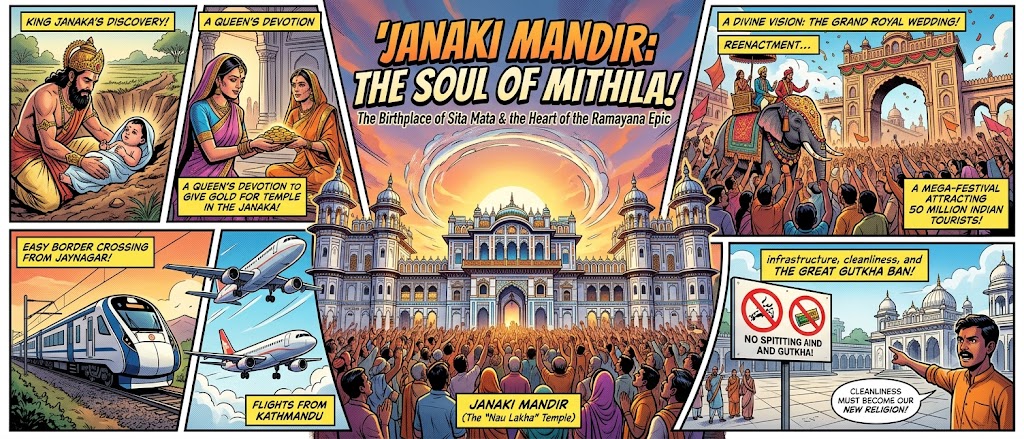
In the vibrant heart of Janakpur lies the Janaki Mandir, a dazzling white marble marvel that serves as the spiritual epicenter of the Mithila region. Also known affectionately as the "Nau Lakha Mandir" because it cost exactly nine lakh rupees to build, this stunning three-story temple was constructed in 1910 by Queen Vrisha Bhanu of Tikamgarh. Blending brilliant Rajput, Mughal, and traditional Nepali architectural styles, it features over 60 rooms decorated with colored glass, engravings, and paintings. It stands on the exact holy ground where King Janaka once ruled and where Goddess Sita was miraculously discovered in a furrow. Every evening, the temple comes alive with spectacular lighting and aarti, making it a living, breathing museum of continuous faith.
The Ayodhya Equivalent: The Power of Sita Mata
While Ayodhya has rightfully seen a massive resurgence in pilgrimage and global attention, Janakpur undeniably holds the exact same level of spiritual significance. Let us be completely honest and candid about the epic: without Sita Mata, Lord Rama would be just another husband. She is the true anchor of the Ramayana, the embodiment of devotion, sacrifice, and immense resilience. Janakpur is the city of the divine bride, the place where her story began. To worship Rama without honoring the soil that nurtured Sita is an incomplete pilgrimage; her strength is the catalyst for the entire epic.
The 50 Million Tourist Vision: A Grand Royal Wedding Reenactment
Right across our porous southern border lies a massive demographic goldmine. There are more than 300 million Biharis and UP wallahs living just a stone's throw away, deeply connected to this lore. If we play our cards right, we can easily attract 30 million Indian tourists from these neighboring states alone, potentially scaling up to an astonishing 50 million tourists from all over India annually. How? By transforming the traditional Vivah Panchami into an internationally broadcast, meticulously organized annual Lord Rama and Sita Mata wedding reenactment ceremony. Imagine a multi-day mega-festival featuring grand chariot processions, decorated elephants, traditional Maithili folk singing, and divine theater that draws devotees the same way global spiritual hubs do.
The Prerequisite: Infrastructure, Cleanliness, and the Great Gutkha Ban
However, grand visions require grounded realities. Before we can host tens of millions of devotees, we must drastically overhaul our tourism infrastructure. We need wider roads, a massive increase in world-class dharamshalas, high-quality vegetarian dining, and modern sanitation facilities. Most importantly, the local government must strictly enforce a total ban of gutkha itself to promote the Janaki Temple. We cannot invite the world to our holiest site only to greet them with red-stained walls, spit-covered corners, and littered streets. Cleanliness must become our new religion. Implementing a pristine, sacred, and strictly hygienic environment is the ultimate sign of respect to both the deity and the pilgrims.
Crossing Borders: How to Reach the Heart of Janakpur
Getting to this spiritual capital is becoming easier and more accessible than ever, solidifying the famed "Ramayana Circuit." If you are traveling from Kathmandu, you can either take a quick, scenic 25-minute domestic flight directly to Janakpur Airport, or embark on a beautiful 6-to-8-hour drive down the winding BP Highway. For our Indian neighbors arriving from across the border, the journey is incredibly seamless. Devotees can take the cross-border broad-gauge train from Jaynagar in Bihar directly into Janakpur. Alternatively, visitors can simply drive their vehicles across the border at Bhitthamore, where a short, straightforward taxi or bus ride will drop you right at the magnificent temple gates.