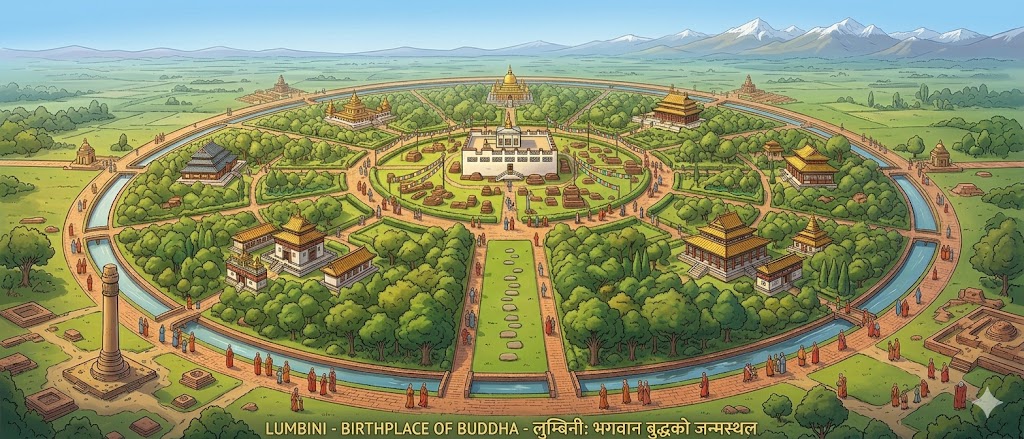
Welcome to Lumbini, the ultimate sanctuary of global peace and the birthplace of Siddhartha Gautama. If you think your local ward office takes a long time to approve a simple blueprint, brace yourselves: the Lumbini Development Master Plan, designed by legendary Japanese architect Prof. Kenzo Tange, has been "in progress" for an astonishing 48 years.
Originally slated for a neat 17-year completion window back in 1978, our successive governments have treated it with a level of Zen-like patience that borders on a collective national coma. Fund officials and a revolving door of political appointees are practically exhausted from talking about it. Yet, we live in eternal, selective optimism that this masterpiece will be completed before the next millennium, finally unlocking our dream of attracting 10 million tourists a year to completely balance our national books.
Why You Must Visit: Especially Right Now
If your spirit is feeling thoroughly crushed by the daily grind of reading the news, navigating broken roads, or watching cooperative scams unfold, Lumbini is the ultimate spiritual detox. Visiting this sacred ground isn't just about sightseeing; it is about grounding yourself in a space dedicated entirely to compassion, mindfulness, and peace.
This matters now more than ever because we are currently in the sacred month of Saga Dawa (the Sakwa/Saka lunar month). This is the holiest period on the Buddhist calendar, commemorating the three most pivotal moments in the Buddha’s existence: his birth right here in the valley, his enlightenment, and his parinirvana. Walking through the gardens during this month offers an unparalleled atmosphere of collective devotion, vibrant prayer flags, and a rare, genuine tranquility that you simply cannot find anywhere else in the country.
The Sacred Target: The Mayadevi Temple & Beyond
At the absolute core of your journey sits the Mayadevi Temple, housing the exact marker stone where Queen Mayadevi gave birth under a Sal tree. It is surrounded by ancient monastic ruins, the historic Ashoka Pillar, and the peaceful Sacred Garden.
Flanking the central canal is the International Monastic Zone, which functions like an architectural World Cup of Buddhism. To the east, you have the Theravada monasteries built by Sri Lanka, Thailand, and Cambodia; to the west, the Mahayana strongholds of China, South Korea, and France. It’s a beautiful, mini global landscape where countries coexist in absolute harmony—a concept our parliament floor has spent two decades completely failing to replicate.
The Strategic Breakdown: Logistics & Survival
-
Best Time to Visit: October to March is ideal, but the spiritual energy of the Saga Dawa month makes the summer heat entirely worth braving. Just pack an umbrella and plenty of water to survive the Terai sun.
-
How to Get There: You can opt for a grueling, bone-rattling 10-hour bus ride from Kathmandu. Alternatively, you can fly into Gautam Buddha International Airport (GBIA) in Bhairahawa. Granted, GBIA currently operates with the structural efficiency of a ghost town—mostly hosting emergency landings and chartered flights while struggling against diplomatic hurdles—but it remains your fastest route. From Bhairahawa, it’s a smooth 45-minute taxi ride to the holy site.
-
The Budget: Entry to the Sacred Garden is incredibly nominal for locals (around Rs. 20 for locals, Rs. 300 to Rs. 600 for SAARC and international tourists). Rickshaw rides through the vast Monastic Zone will cost you anywhere from Rs. 500 to Rs. 1,500, depending entirely on your ability to negotiate without looking like a wealthy corporate sponsor. Hotel options range from budget-friendly pilgrim inns to luxury resorts, meaning a weekend spiritual reset can cost anywhere from Rs. 5,000 to Rs. 25,000.