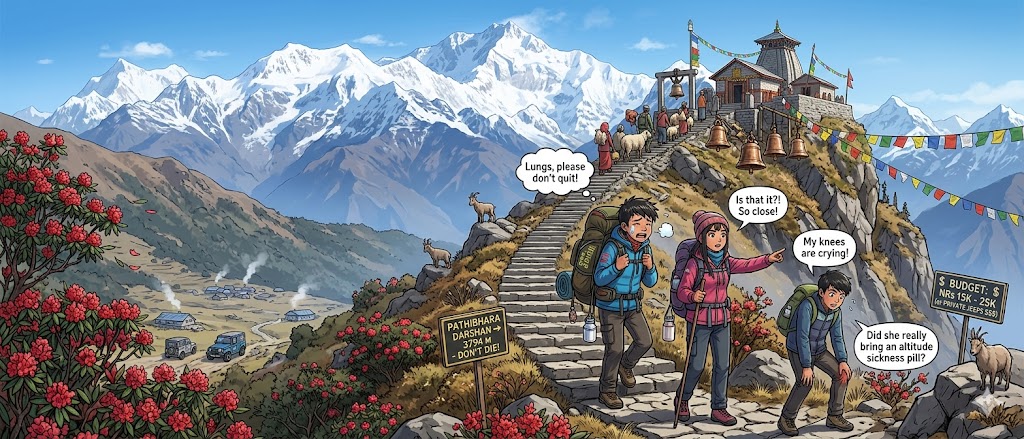
Welcome to the Taplejung district in the far-eastern corner of Nepal, a place so remote that even Google Maps occasionally gives up and prays for guidance. The Pathibhara Devi Temple sits majestically at a lung-crushing altitude of 3,794 meters above sea level.
To put that in perspective, you will be breathing air so thin that your bad decisions from high school will start making perfect sense. It balances on a ridge that offers a stunning 360-degree view of the Kanchenjunga range, assuming your eyes aren't completely swollen from crying and gasping for oxygen.
Historical Significance: Sheep, Sacrifices, and a Sovereign Shakti Peeth
According to local legends, the temple's origin story reads like an ancient thriller. Centuries ago, local shepherds lost thousands of their sheep on this exact hill and fell into a collective panic attack. The Goddess then slid into their dreams, dropped a classic "worship me or say goodbye to your livestock" ultimatum, and the moment the sacrifices were made, the sheep magically reappeared.
Today, it is revered as a mighty Shakti Peeth—one of the holy sites where pieces of Goddess Sati's body fell. The local indigenous Limbu community calls the hill Mukumlung, which translates to a source of ultimate divine power. Basically, she is the ultimate "Goddess of Desires"—you climb up, ask for a promotion, a wife, or a lottery win, and if your devotion is pure, she grants it.
Best Time to Visit: The "Don't Die on the Trail" Window
You can technically visit whenever your soul feels guilty, but if you value your life, aim for Spring (March to May) or Autumn (September to November). Spring treats you to blooming red rhododendrons, making you feel like a movie star while you are secretly hyperventilating. Autumn gives you crystal-clear skies and mountain vistas so sharp they’ll slice through your existential dread. Avoid the monsoon season unless your lifelong dream is to become a walking buffet for a million highly motivated mountain leeches on slippery, vertical mudslides. Winter is also a hard pass unless you enjoy being turned into a human popsicle in sub-zero weather.
The Budget: Cheaper Than Therapy, Pricier Than Local Chiya
-
The "Ayo Gorkhali" Budget Pack: NPR 15,000 to 25,000 per person (if you take local buses, share local jeeps, eat Dal Bhat twice a day, and possess the leg strength of a mountain goat).
-
The "Rich City Brat" Pack: NPR 50,000+ if you book private Scorpio jeeps, demand hot showers where water freezes instantly, or try to bribe locals to carry you up the final stairs.
The trail from Kaflepati involves a brutal, relentless uphill hike of 4 to 5 hours on stone stairs designed by someone who clearly hated human knees. Accommodation along the way consists of ultra-basic teahouses where the blankets are heavy, the wooden walls are paper-thin, and your neighbor's snoring will harmonize beautifully with the mountain wind. Pack heavy layers, bring altitude sickness pills, and leave your fragile ego at the base camp!