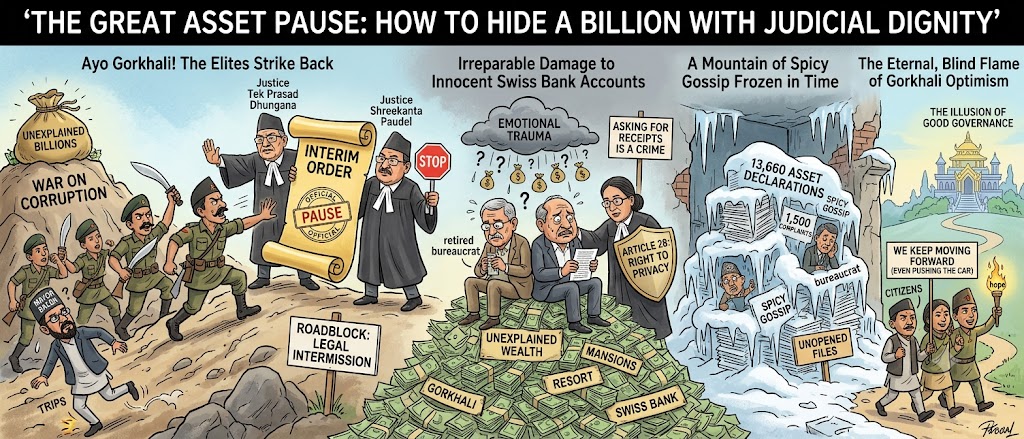
Ayo Gorkhali! Sound the bugles, light the incense, and bury your gold bars in the backyard, because our grand national war against corruption has crashed face-first into its absolute favorite Nepalese milestone: a beautifully articulated legal intermission. Just as the high-level Property Investigation Commission was getting ready to pry open the heavy steel vaults of our nation's most "financially blessed" public servants, the Supreme Court swooped in like a majestic, protective older brother.
With a swift, heroic wave of their judicial robes, Justices Tek Prasad Dhungana and Shreekanta Paudel issued an interim order effectively telling the commission to sit down, shut up, and stop causing unnecessary anxiety to our poor, overworked elites. It is a masterclass in Nepalese political theater—we march toward transparency with fierce Gorkhali bravery, only to trip over a constitutional shoelace carefully tied by the very system we are trying to fix.
Irreparable Damage to Innocent Swiss Bank Accounts
The dark humor in this judicial twist is so pure it belongs in a museum. The Supreme Court solemnly declared that allowing the investigation to continue could cause "irreparable legal consequences" and harm to the individuals involved. Oh, the humanity! Can you even fathom the deep, psychological trauma of forcing a retired bureaucrat or a former judge to explain how their modest civil service salary magically multiplied into three palatial mansions in Kathmandu and an estate in Pokhara?
The court’s heart absolutely bleeds for their right to privacy. God forbid we violate Article 28 of the Constitution, which apparently guarantees the sacred, fundamental right to hide bags of unexplained cash under your personal driver's cousin’s name. The sarcasm truly writes itself: in this beautiful federal republic, asking for financial receipts is treated as the real crime, while accumulating unexplainable wealth is just a harmless hobby protected by the highest court in the land.
A Mountain of Spicy Gossip Frozen in Time
Before the court hit the giant, golden pause button, the commission under retired justice Rajendra Kumar Bhandari was actually guilty of doing the unthinkable—they were working. Spokesperson Ganesh KC revealed they had already gathered a staggering 13,660 asset declarations and over 1,500 incredibly spicy public complaints. They were planning to dig three generations deep into the financial family trees of these public servants, tracking down hidden wealth stashed with spouses, relatives, and office assistants.
High-profile figures like former Prime Ministers and former army chiefs had already surrendered their paperwork, probably sweating through their designer suits. But fear not, dear leaders! Those 13,000 files are now locked away, unopened and unexamined, safely insulated from the dangerous, terrifying threat of public accountability. They will sit there gathering pristine dust while a three-judge full bench and a freshly summoned squad of amicus curiae spend months debating whether asking politicians to be honest is technically legal.
The Eternal, Blind Flame of Gorkhali Optimism
But do not lose heart, brave citizens, for this is exactly where our fierce, unyielding Gorkhali optimism shines brightest! While the commission’s work is frozen in a state of tranquil suspended animation, the Office of the Prime Minister insists they are actively examining "legal remedies" to ensure anti-corruption efforts aren't brought to a complete standstill.
We must maintain absolute, delusional hope that this judicial intermission is just a dramatic cliffhanger in Nepal's longest-running blockbuster franchise, The Illusion of Good Governance. Perhaps, in a spectacular twist of fate, the full bench will eventually give the green light, the dust will be blown off those 13,000 files, and justice will land like a thunderbolt. Until that mythical day arrives, let us marvel at our system’s flawless, organic ability to protect its own, take a deep breath of Kathmandu's dusty air, and remember the golden rule of the republic: in Nepal, your secrets are always perfectly safe, provided your bank account is large enough to afford the right constitutional experts.
Jai Nepal!