Good Morning Nepal!
1. The Eternal Wanderer of Nepali Politics
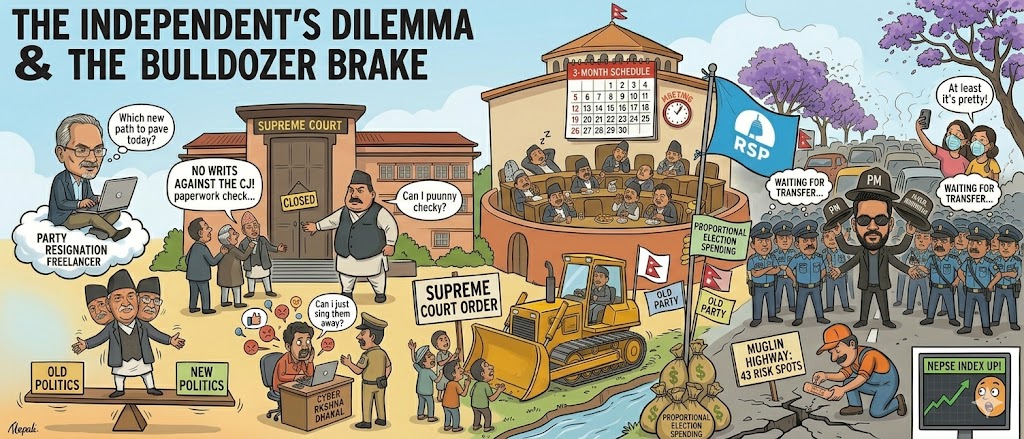
Dr. Baburam Bhattarai has officially left his latest party to become a "freelance" revolutionary, because apparently, being a former PM isn't enough of a full-time job. It’s peak Gorkhali comedy to watch a man who helped rewrite the nation’s history spend his retirement years collecting party resignations like they’re loyalty stamps at a trendy coffee shop. We are all waiting to see if he starts a "Party of One" or just continues to tweet his way into the next coalition while the rest of us try to keep up with his ideological parkour. However, there is a flicker of hope in his restless persistence; it proves that in Nepal, even if you fail at "Alternative Politics" ten times, there’s always an eleventh attempt waiting to be rebranded.
2. Character Assassination & The Cyber-Bureau
Legendary singer Ram Krishna Dhakal has finally hit the "limit" on social media vitriol and has taken his grievances straight to the Cyber Bureau. It is hilariously ironic that in a country where we can block a major highway for an entire day over a pothole, we still haven't figured out how to block a single bored troll with a keyboard. We are "civilized" enough to stream his classic hits on repeat, yet we act like digital barbarians the moment we see a comment section open for business. The hope here is that a high-profile case might actually force the Cyber Bureau to do more than just reboot their routers; perhaps we’re finally moving toward a world where "online freedom" doesn't mean "freedom to be a jerk."
3. The Chief Justice "Bouncer" Protocol
The Supreme Court administration has pulled a classic power move by refusing to even register the petitions against the proposed Chief Justice, Dr. Manoj Sharma. It’s the ultimate sarcasm: the very court that is supposed to be the "final hope" for the marginalized is currently acting like an elite nightclub bouncer, telling senior advocates their paperwork isn't on the VIP list. One has to laugh at the sheer audacity of a system that "protects" itself by simply ignoring the people who know the law best. Yet, the fact that lawyers are still lining up to file these writs gives us hope—it shows the legal community hasn't yet traded its backbone for a comfortable seat on a committee.
4. The Three-Month Parliament "Mirage"
Parliament has released a shiny, optimistic new calendar for the next three months, promising to actually pass laws instead of just creative insults. It’s deeply sarcastic to think that a "potential schedule" in the House of Representatives has any more weight than a weather forecast in a mid-monsoon landslide zone—subject to change the moment someone’s microphone gets cut. We’ll believe the "Budget Presentation" happens on time when we see the red briefcase, and not a minute before we've endured three hours of shouting. Still, having a plan is a small victory; it gives the public a benchmark to measure exactly how much taxpayers' time is being spent on snacks versus statutes.
5. The Supreme Brake on Bulldozers
The Supreme Court has officially told the government to park the bulldozers and leave the riverbank settlements alone until they find a better plan than "just move." After weeks of high-definition "urban cleanup" videos designed for TikTok fame, the legal system has reminded the administration that "human rights" isn't just a pesky footnote in a city planning manual. It’s peak sarcasm to watch the government try to build a "Smart City" by simply deleting the residents who don't fit the aesthetic of a luxury apartment ad. The hope lies in this check of power; it proves that even in a bulldozer-happy political climate, the law still remembers the people who don't have a PR team.
6. The High Cost of "New" Politics
The Election Commission recently revealed that the National Independent Party (RSP) outspent the "Old" parties in the proportional election race, proving that change comes with a hefty price tag. It’s hilarious to see the "Common Man’s Party" sporting a campaign budget that makes the century-old Congress machine look like it’s running on a bake-sale allowance. We were promised a new era of politics, but it seems the new era still requires the same old millions for billboards, social media ads, and mass-produced bells. However, there’s hope in the transparency; at least we’re finally seeing the receipts, which is a massive upgrade from the "hidden suitcase" era of the past.
7. The Seven-Point Dissent
Opposition leader Bhishmaraj Angdembe has filed a formal 7-point disagreement over the Chief Justice selection, accusing the Prime Minister of turning the judiciary into a personal playground. It’s a classic Gorkhali political dance: you only start quoting the "Spirit of the Constitution" when you’re no longer the one holding the pen that signs the appointments. The sarcasm is thick enough to choke on, as both sides argue about "independence" while clearly looking for a judge who likes their particular brand of politics. Yet, formal dissent is a healthy sign of life; it’s a reminder that no matter how much the government tries to steamroll, there’s always someone willing to stand up and say, "I disagree."
8. The Home Minister Ghost Office
Because Prime Minister Balen Shah is still doubling as the Home Minister, thousands of routine police transfers are currently frozen in a bureaucratic ice age. It’s the height of sarcasm that we live in a "Digital Nepal" where the security of the nation’s districts is waiting for one man to find a spare hour between his ten other high-profile portfolios. We’ve essentially turned our police force into a "Waiting Room Force," where every Inspector and SSP is just staring at their phone hoping for a notification that never comes. The hope? Maybe the police will realize they can function perfectly well without a political babysitter, leading to a truly professional and independent service by sheer accident.
9. The Landslide Budget Paradox
Engineers have identified 43 high-risk landslide spots on the Muglin-Narayanghat highway, but due to "budget constraints," they are only fixing exactly one of them. It’s the ultimate Gorkhali sarcasm to call this a "Priority Highway" when we treat its survival like a luxury hobby that we can only afford once every few fiscal years. We are essentially asking commuters to play a 43-to-1 game of chance every time it rains, which is a bold strategy for a country trying to boost tourism. Still, the call for tenders at Tuin Khola is a start; let’s just hope the other 42 spots have the patience to stay attached to the mountain until the next budget cycle.