Good Morning Nepal
1. The Invisible Traffic Man
Kathmandu Roads to Go "Ghost Protocol"
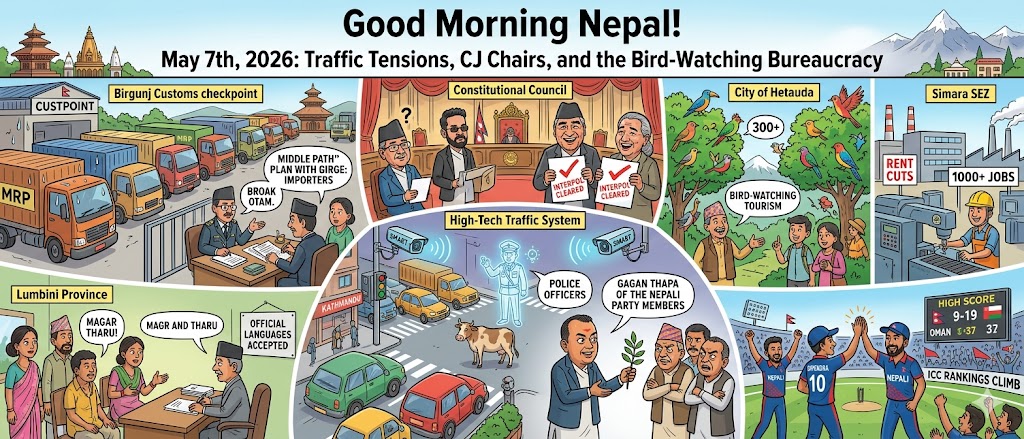
The Metropolitan Traffic Police have announced they are removing physical officers from several key Kathmandu intersections starting today. Instead of a frantic whistle-blower in a dusty mask, we’re expected to obey AI-powered cameras and "smart" signals that hopefully have more patience than the average taxi driver. It’s a bold move toward modernization, or perhaps just a way to save our officers from inhaling the equivalent of three packs of cigarettes a day. We’re all for tech, but let’s see how the "smart" system handles a stray cow or a VIP motorcade that refuses to believe in red lights.
2. The Chief Justice Musical Chairs
Constitutional Council Finally Remembers its Password
Prime Minister Balen Shah has called a high-stakes Constitutional Council meeting for today to finally recommend a new Chief Justice. After months of the judiciary running on "safe mode," the government is scrambling to fill the top spot before the legal backlog becomes a sentient entity. The President’s recent ordinance seems to have greased the wheels, even if the opposition thinks the wheels are falling off the democracy wagon. We’re just hoping the new CJ has a very comfortable chair—they’re going to be sitting through a lot of "urgent" petitions about everything from squatter evictions to trade union bans.
3. The "Middle Path" MRP Maneuver
Customs Officials Play Negotiator for the Border Blockade
The Customs Department is desperately trying to break the Birgunj deadlock by adopting a "middle path" for goods lacking the mandatory Maximum Retail Price (MRP) labels. Importers have been playing a high-stakes game of "chicken" with the government, letting 1,400 trucks turn into expensive ovens in the Raxaul sun. The new compromise allows some flexibility, proving that in Nepal, "mandatory" usually means "subject to a very long meeting." If the labels don't stick soon, our electronics market might start looking as empty as a government office during a local festival.
4. The Bird-Watcher’s Budget
Hetauda Discovers 300 Reasons to Keep its Trees
In a rare bit of "Green News," Hetauda has officially cataloged over 300 bird species living within city limits, making it the unofficial avian capital of the Bagmati province. While the rest of the country is busy paving over every square inch of dirt, Hetauda is accidentally becoming a sanctuary for feathered tourists who don't need a visa. Local officials are already eyeing "bird-watching tourism" as a way to boost the municipal purse without building another shopping mall. It’s a lovely thought, provided the birds don't mind the sound of the nearby industrial district’s generators.
5. The Interpol "Red Face" Moment
Deuba Couple Cleared of the International "Naughty List"
Interpol has officially denied issuing a Red Notice against the Deuba power couple, asking the Nepali authorities for "actual evidence" instead of just political spicy-talk. It seems the global police agency isn't quite ready to join our local game of political tag without a bit more paperwork. The "investigation" continues, but for now, the only thing getting arrested is the rumor mill that had them fleeing to London by Tuesday. It’s a classic reminder that while our internal politics are a thriller, the rest of the world requires a slightly more boring thing called "proof."
6. The "Sleeper Cell" Sweep
Gagan Thapa Tries to Fix the Congress "Ice-Breaker"
Nepali Congress President Gagan Thapa is currently in "fixer" mode, meeting with various party factions to prevent the grand old party from turning into a grand old pile of splinters. After the "September Uprising" fallout, the party is struggling to figure out if it's an opposition, a partner, or just a collection of very confused leaders. Thapa is reportedly offering "olive branches" to the disgruntled Shekhar-Gagan camp, which sounds a lot like promising more committee seats. We’re watching to see if the "ice-breaker" actually clears the path or just makes the water colder for everyone involved.
7. The Simara SEZ Surge
Rent Cuts Prove That "Cheap" Is the Best Policy
The Special Economic Zone (SEZ) in Simara is finally seeing a surge in investment after the government finally lowered the land rent to something resembling reality. Nearly a dozen new industries are under construction, promising over 1,000 jobs to people who would otherwise be looking at flight tickets to Qatar. It turns out that if you don't charge entrepreneurs the price of a Penthouse in Dubai for a plot of dirt, they might actually build something. Now, if we can just get the electricity to stay on long enough to run a sewing machine, we might actually have an industrial revolution.
8. The Antar-Pradesh Language Twist
Lumbini Demands Official Status for Magar and Tharu
The Lumbini Province is pushing for Magar and Tharu to be recognized as official working languages, adding a much-needed layer of local flavor to the bureaucracy. It’s a significant step toward the "Federalism" we were promised, even if it means some old-school clerks will have to learn a few new phrases. While the center is busy cutting ministries, the provinces are busy defining who they actually represent. We’re all for it—nothing says "representative government" like being able to tell a civil servant you’re annoyed in your mother tongue.
9. The Cricket Comeback
Dipendra and Sandeep Climb the ICC Rankings
In the only consistent win for the national ego, Dipendra Singh Airee and Sandeep Lamichhane have made significant jumps in the latest ICC rankings after their Oman demolition. While the politicians are arguing over "Ordinance Culture," our boys are out there proving that Nepal’s "spin" is actually world-class. The victory in Kirtipur has kept the League-2 dream alive, giving the "12th Man" (the fans) a reason to keep buying tickets. We just hope the team’s momentum is more sustainable than the air quality in Kathmandu after a two-day rain break.