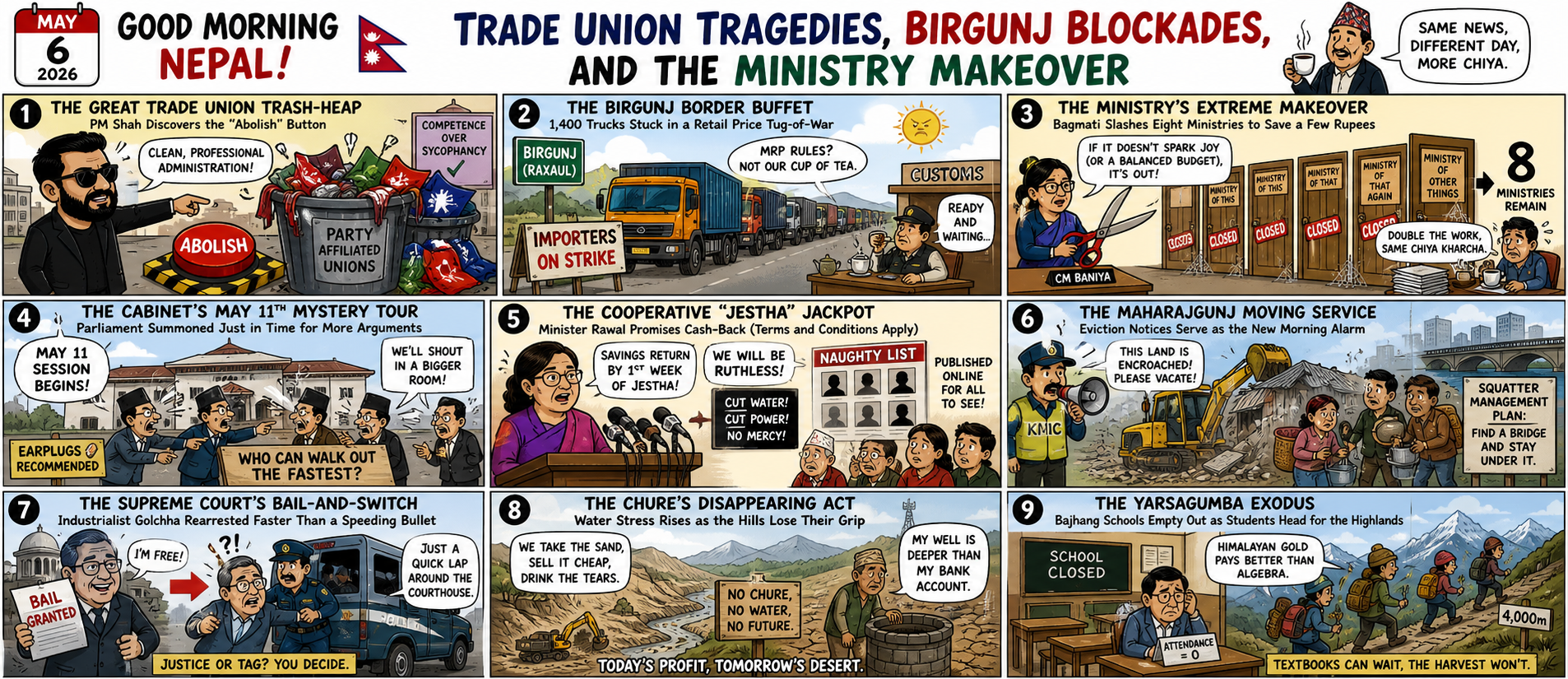
Good Morning Nepal!
1. The Great Trade Union Trash-Heap
PM Shah Discovers the "Abolish" Button
Prime Minister Balen Shah has officially declared war on party-affiliated trade unions, claiming they ruin bureaucracy and schools. He’s promising a "clean and professional" administration, which is political speak for "I’m firing everyone who wears the wrong colored scarf." Apparently, if the Rastriya Swatantra Party wanted their own unions, they could make them "in no time," but they’re staying humble—or just busy. The only thing deeper than the "sleeper cells" he’s purging is the irony of a politician demanding a politics-free zone. We’re all for competence over sycophancy, but let’s see if the new system works better than a broken photocopy machine.
2. The Birgunj Border Buffet
1,400 Trucks Stuck in a Retail Price Tug-of-War
Over a thousand trucks are currently chilling at the Birgunj border because importers aren't fans of the new Maximum Retail Price (MRP) rules. Importers have basically gone on strike, leaving everything except vegetables and oil to bake in the Raxaul sun. Customs officials are "ready and waiting," which means they’re sitting around drinking tea while the supply chain has a nervous breakdown. The government wants price transparency, but all we’ve gotten so far is a very expensive parking lot for cargo. If this lasts another week, we might have to start importing basic common sense instead of electronics.
3. The Ministry’s Extreme Makeover
Bagmati Slashes Eight Ministries to Save a Few Rupees
The Bagmati provincial government decided it had too many chefs in the kitchen and cut its ministry count down to eight. It’s the ultimate "Marie Kondo" move for the cabinet: if the ministry doesn't spark joy (or a balanced budget), it’s headed for the exit. CM Baniya is feeling the heat after recent raids, so a little belt-tightening is a great way to look busy while sweating. The remaining ministers will now have to do double the work for the same amount of "Chiya Kharcha." We’re waiting to see if this efficiency actually results in a single paved road or just more crowded office chairs.
4. The Cabinet’s May 11th Mystery Tour
Parliament Summoned Just in Time for More Arguments
The Cabinet has officially recommended that the federal parliament session begins on May 11th, so sharpen your earplugs, folks. After weeks of ordinance-shuffling and "firm" letters, our leaders are finally getting back together to shout in a larger room. The President is expected to sign off on the date faster than a contractor signs for a mobilization fund. We can expect high-level debates on everything except the things that actually matter to the person on the street. It’s going to be a blockbuster season of "Who Can Walk Out the Fastest" starting next Monday.
5. The Cooperative "Jestha" Jackpot
Minister Rawal Promises Cash-Back (Terms and Conditions Apply)
Minister Pratibha Rawal has pledged that the government will start returning savings to cooperative victims by the first week of Jestha. She’s promising to be "ruthless" with debtors, even threatening to cut off their water and electricity like a very angry landlord. While victims have heard this tune before, the government is now publishing a "Naughty List" of debtors on their website for all to see. We’re all hoping "ruthless" means actual checks in hands and not just a very sternly worded press release. If the money doesn't show up, the government might find its own political "public services" getting cut off by the voters.
6. The Maharajgunj Moving Service
Eviction Notices Serve as the New Morning Alarm
The Kathmandu Metropolitan City is busy clearing informal settlements behind the Teaching Hospital, turning decades of lives into a pile of rubble. Protesters and Gen Z victims are finding out that "system change" usually means getting kicked out of your home with a megaphone announcement. It’s a tragic scene of families wrapping up utensils while the city’s bulldozers warm up their engines in the background. The KMC says it's clearing encroached land, but the "squatter management" plan seems to be "find a bridge and stay under it." At this rate, the city will be beautifully paved, but there might not be anyone left who can afford to walk on it.
7. The Supreme Court’s Bail-and-Switch
Industrialist Golchha Rearrested Faster Than a Speeding Bullet
Shekhar Golchha was re-arrested just hours after the Supreme Court granted him bail, proving that our legal system is a very confusing carousel. One minute you’re walking free, the next you’re back in a police van wondering if the bail papers were written in invisible ink. The authorities seem determined to keep the high-profile investigations going, even if it means doing a lap around the courthouse. It’s the ultimate legal "gotcha" moment that has the entire business community checking their own locks. Whether this is justice or just a very aggressive game of tag remains to be seen.
8. The Chure’s Disappearing Act
Water Stress Rises as the Hills Lose Their Grip
A new report warns that the Chure hills are weakening so fast that the Tarai might soon become a desert with better cell service. Years of overexploitation for sand and gravel have left the land as dry as a government apology for the fertilizer crisis. Water stress is rising, and farmers in the plains are wondering why their wells are deeper than their bank accounts. We are literally selling the dirt under our feet to build houses that won't have a drop of water to drink. It’s a slow-motion disaster that we’re currently ignoring in favor of arguing about trade unions.
9. The Yarsagumba Exodus
Bajhang Schools Empty Out as Students Head for the Highlands
Over 50 schools in Bajhang have shut down because the students have decided that picking Himalayan gold is more profitable than algebra. Teachers are sitting in empty classrooms while the kids are climbing to 4,000 meters to harvest the "Himalayan Viagra" for the season. Education is important, but when the harvest can pay for a year of food, the textbooks don't stand a chance. The government’s "school calendar" is no match for the economic reality of a fungi-based economy. We wish them luck on the peaks, because they’ll need a lot more than a passing grade to survive that climb.