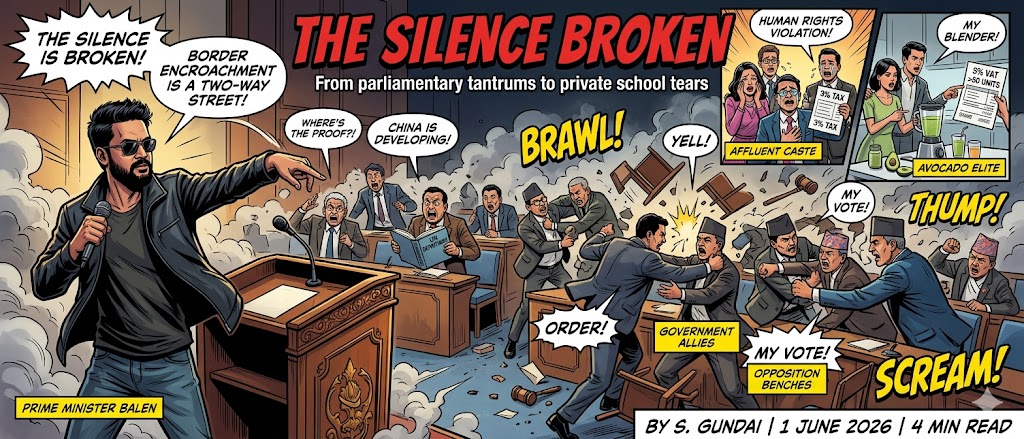
The nation held its collective breath. For months, Prime Minister Balendra "Balen" Shah maintained a silence so deep you could hear the structural integrity of the old political guard crumbling. Then, he finally stepped up to the parliamentary podium. Instead of the usual diplomatic sweet-talk, the Gen Z icon-turned-premier delivered a classic, unfiltered Balen performance, instantly setting the house on fire and sending shockwaves across the border.
When the Map Gets Re-Encroached
The highlight of the session arrived when PM Balen casually asserted that border encroachment is a two-way street. Responding to queries about historical border disputes, he nonchalantly claimed that Nepal has also encroached upon Indian territory in several places. The main opposition, Nepali Congress, immediately suffered a collective panic attack, demanding empirical proof or an immediate expunging of the remarks. To top off the geographic comedy, Balen confidently used China as a prime example of a country that recently graduated to "developed" status, leaving opposition MPs frantically pulling up UN definitions to point out that Beijing still identifies as a developing economy.
The House of Un-Representatives
However, the real show started after Balen finished his monologue, adjusted his dark shades, and exited the building. The moment the executive gravity left the room, the Parliament transformed from a legislative body into a full-blown tavern brawl. Lawmakers from the opposition benches collapsed into a state of tribal warfare. There was no debate, no policy critique—just raw, unadulterated lung power.
MPs began screaming over microphones, banging desks, and gesturing wildly as if they were settling a dispute over a spilled local brew rather than managing a sovereign republic. The Speaker frantically banged the gavel, trying to tame a room full of adults who apparently view parliamentary privilege as an immunity card for absolute rowdiness. It is a recurring national tragedy that our esteemed lawmakers consistently mistake the sacred floor of Singha Durbar for a cheap bar room alley where the loudest shout wins.
The Audacity of the Affluent Tears
While the parliament chose violence, the real comedic tragedy unfolded over the newly unveiled fiscal budget. Finance Minister Swarnim Wagle introduced a 3% Education Equality fee on private school tuition and a 5% concessional VAT on electricity consumption exceeding 50 units. Almost instantly, a symphony of wealthy weeping echoed across the digital stratosphere of Kathmandu.
Let us pause and appreciate the sheer irony. Parents who willingly cough up hundreds of thousands of rupees a year so their children can learn British accents at elite private academies are suddenly throwing a historic tantrum over a 3% levy. They will joyfully pay a 10% service charge on a mediocre platter of sizzling chicken sizzler at a lounge, but ask them to contribute a fraction of that to fund public child nutrition in remote areas, and suddenly it is a human rights violation.
Powering Down the Hypocrisy
The outrage turns even more farcical when it comes to the new 5% electricity VAT for users burning through more than 50 units a month. If your household consumption crosses that 50-unit threshold, you are clearly not just lighting a couple of basic LED bulbs. You are running multiple heavy appliances and high-tech blenders to make your morning avocado smoothies.
Crying about a minor levy on luxury power usage while the state needs to invest 85 billion rupees into the energy sector is peak hypocrisy. This nominal tax is precisely what funds the construction of high-voltage transmission lines. For decades, the middle and upper classes have whined about unreliable infrastructure, yet the moment they are asked to pay a modest fee to help build a truly sovereign, fully electric nation, they act as if the government is stealing their ancestral land.
If you can afford the premium price tag of private schooling and a house full of humming appliances, you can certainly survive a tiny contribution toward fixing the systemic rot. Funding community schools and expanding our domestic grid is not oppression—it is the bare minimum required to stop exporting our youth and start exporting our electricity. It is time to turn off the waterworks, pay the bill, and let the country power up.
Jai Nepal!