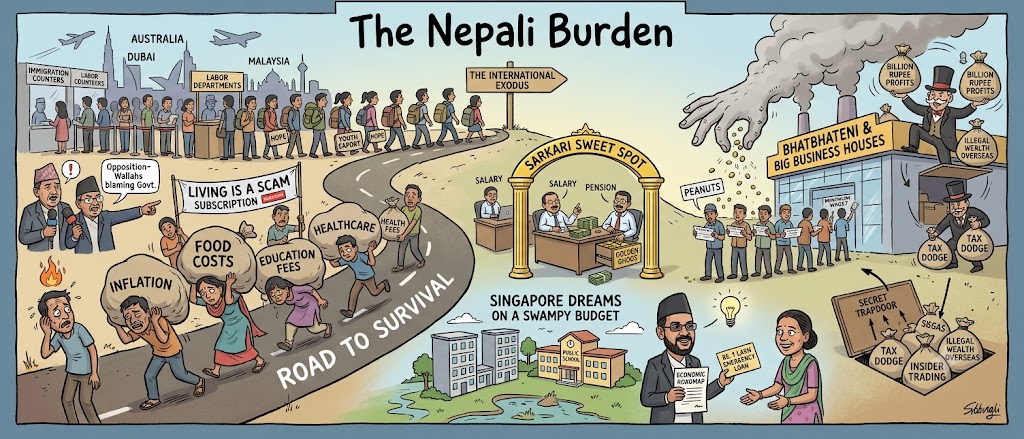
In the past few weeks, we have witnessed the ultimate, albeit tragic, form of public protest: citizens setting themselves on fire over financial stress. Naturally, the opposition wallahs wasted no time blaming the current government, because why lose a good political photo-op? Yet, nobody actually wants to talk about the real culprit: the cost of just breathing in this country. Between inflation and the soaring costs of food, education, and healthcare, surviving has become a premium subscription we can't afford.
The Sarkari Sweet Spot
If you want to survive the Nepali economic hunger games without resorting to extreme measures, your best bet is becoming a government employee. The sarkari life is beautifully insulated. Now, let’s be fair—not all of them are corrupt, and not everyone gets a turn at the golden ghoos (bribe) counter when service seekers walk in. But regardless of whether they have the opportunity to park illegal wealth overseas, they all get paid vastly better than the private sector. While the rest of us play financial Russian roulette every month, our bureaucratic heroes enjoy the soothing warmth of job security and guaranteed pensions.
The Billion-Rupee Peanut Factory
We love to celebrate our corporate titans. We sing praises of Bhatbhateni and the big business houses for employing a few hundred thousand Nepalis. "Look at them, employing 22,000 folks at their departmental stores!" they cry. What they conveniently leave out is the concept of a fair wage. Sure, you have a job, but your salary is a mathematical marvel—perfectly calculated to ensure you cannot save a single rupee after paying for your room rent, basic food, and the privilege of walking to work. Our minimum wage is theoretically around Rs. 20,000 a month, but look deep into the underbelly of our businesses, and 90% don't even pay that.
The Art of the Corporate Tax Dodge
Every year, these same business houses miraculously report billions in profit. Then, they show us their immense kindness by donating a fraction of it to schools and hospitals, or handing out scholarships to underprivileged kids. It’s enough to make you cry, until you realize it’s the ultimate magic trick. Behind the philanthropic curtain, many have been allegedly busy engaging in insider trading, evading taxes, grabbing public land, and faking VAT bills to gather illegal wealth. Once the harvest is complete, they send it overseas for their own financial security.
Singapore Dreams on a Swampy Budget
Instead of watching this theater, the government needs to focus on affordable education, healthcare, and housing. We have tons of public land sitting idle in every single ward. Perhaps our leadership could learn a thing or two from Singapore’s HDB revolution, which turned a swampy town of shanty tin roofs into affordable housing for almost everyone. When it comes to education, it is high time to set a strict ceiling on tuition fees. The state needs to act strongly against our school byaparis who make fortunes while paying their teachers peanuts. The same heavy hand needs to apply to predatory private hospitals and factories.
The International Exodus of the 90%
Let’s face it: it is not easy being a Nepali. If you aren't blessed with old-school ancestral money or the newly minted, illegal sarkari rich money, you belong to the 90% who have to grind it out daily on pure, unadulterated hope. No wonder the moment our kids turn 18, their only ambition is to flee. Depending on their parents' capacity to bag high-interest loans from local sharks, they line up for Dubai, Australia, or Malaysia. It’s our biggest export: youth.
The least the state can do is ensure our migrant workers get some respect. We need to end the discrimination and the toxic bribe-seeking culture at our labor departments, immigration counters, and government agencies. They are funding the nation, after all; stop treating them like cash cows on their way to the slaughterhouse.
Patience, Pragmatism, and the Million-Rupee Hope
We cannot keep blaming the Ranas, the House of Shah, and the old-school political parties forever—even if they did do their absolute best to keep us as one of the poorest nations on Earth. They’ve done their share of looting, and we are reasonably certain this current government will be more honest and accountable. It will take time to rise, and while we are on the right track regarding governance, we still lack pragmatism. PM Balen is doing a solid job meeting entrepreneurs, hearing grievances, and trying to draft an economic roadmap.
If the state wants a practical fix to stop people from hitting the brink, how about providing a Rs. 1 lakh low-interest, 5-year emergency loan to all tax-paying citizens? It could ease the burden when a medical crisis hits or school fees are due, saving families from the jaws of loansharks.
If the government can support the public, focus heavily on exports, and boost tourist arrivals from one million to five million in the next five years, we might actually build an economy where staying home is an option. Until then, we pay our taxes, follow the law, and keep hoping the light at the end of the tunnel isn't an oncoming train.
Jai Nepal!