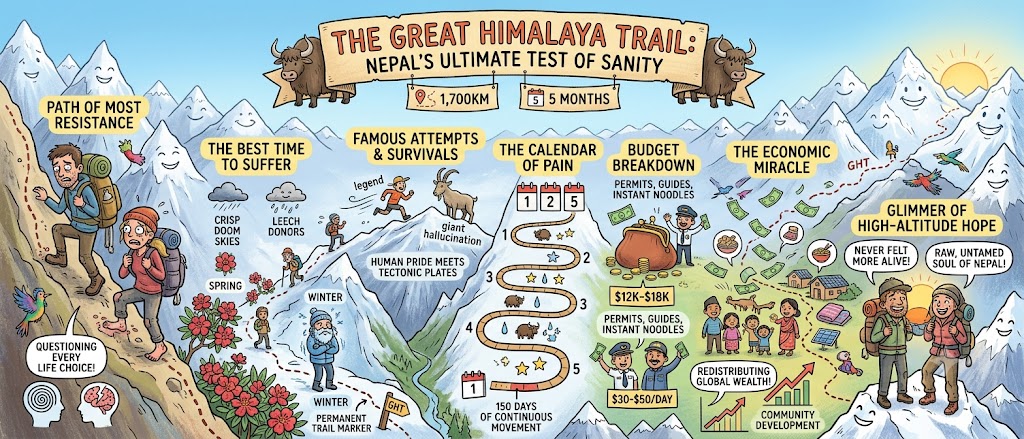
The Great Himalaya Trail is a casual 1,700-kilometer stroll stretching from the eastern tip of Kanchenjunga all the way to the rugged western border of Humla. It is designed specifically for people who find regular therapy far too cheap and breathing actual oxygen way too mainstream. Instead of a pleasant walking holiday, Nepal offers you a vertical rollercoaster where the only safety harness is your sheer, unadulterated stubbornness.
You will routinely traverse passes higher than most European capital cities, navigate trails that are legally classified as "loose rock slides," and question every single life choice that brought you here. Yet, amidst the very real threat of pulmonary edema, there is something deeply, inexplicably spiritual about the journey. It forces you into stripped-down humility.
The Best Time to Suffer
If you wish to survive this massive feat, timing is absolutely everything. The ideal windows are autumn, from September to November, when the skies are crisp enough to see your impending doom, and spring, from March to May, when rhododendrons bloom spectacularly to mock your intense physical agony.
Attempting this during the monsoon means you will be actively donating blood to millions of highly motivated leeches while sliding down vertical mudbanks. Trying it in deep winter guarantees you will become a permanent, frozen trail marker for future generations. Choose your poison wisely; either way, the mountains will welcome you with cold, majestic indifference.
Famous Attempts and Miraculous Survivals
Only a handful of beautifully unhinged souls have conquered the entire network of the Great Himalaya Trail. Legends like Robin Boustead, who painstakingly helped map this madness, and ultra-runners who treat 100-mile mountain ridges like a casual morning jog, have set the bar high.
Most normal mortals, however, attempt a single section, lose a few crucial toenails, hallucinate conversations with a mountain goat, and promptly head back to the nearest teahouse for a warm beer. These glorious, half-failed attempts are a testament to the trail’s legendary status: it is a place where human pride goes to be gently crushed by ancient tectonic plates.
The Five-Month Calendar of Pain
If you are planning to take this on, prepare to say goodbye to your modern life for an extensive timeframe. Completing the full high route takes approximately 140 to 150 days of continuous, bone-crushing movement. That is nearly five months of eating, sleeping, and crying in the shadows of the world's highest peaks. You will need to carefully map out your pace, factor in essential rest days to let your shredded muscles recover, and brace yourself for long stretches of absolute isolation where the concept of a weekend completely loses its meaning.
The Budget Breakdown for Financial Masochists
Conquering the trail requires a bank account as robust as your lungs. If you opt for a fully supported commercial package deal—complete with guides, porters, heavy-duty camping gear, permits, and internal rescue flights—expect a budget ranging anywhere from $12,000 to $18,000 per person.
For those trying to do it independently, you can scrape by on a leaner daily budget of around $30 to $50 for basic food and lodging, though the expensive restricted area permits and mandatory local guides for treacherous zones like Dolpo or Manaslu will still happily bleed your wallet dry.
The Ultimate Economic Miracle
But why should we care about tourists wandering into the middle of absolute nowhere? Simple: it is our best shot at a genuine tourism revolution. Instead of clustering thousands of tourists in Kathmandu to inhale exhaust fumes or clogging the classic Everest trail with luxury-seeking influencers, this trek disperses cash directly into wild, remote communities.
Nothing redistributes global wealth quite like a wealthy foreigner paying premium prices for a hot bowl of instant noodles and a simple wooden plank to sleep on in a high-altitude village. It’s sustainable, community-driven, and forces economic development to climb the mountains itself.
A Glimmer of High-Altitude Hope
Behind the dark humor and the inevitable blister-popping sessions lies a beautiful, shimmering hope. The Great Himalaya Trail represents the raw, untamed soul of Nepal. It proves that we don't need five-star luxury resorts to captivate the world; we just need our vast, terrifying, and ridiculously beautiful backyard. In a world of sanitized, predictable travel, this trail is a raw, heart-stopping reminder of what it actually means to feel alive.
So pack your heavy bags, say goodbye to your loved ones, and come on over—our mountains are waiting to show you who is truly boss. You might just find yourself out there.