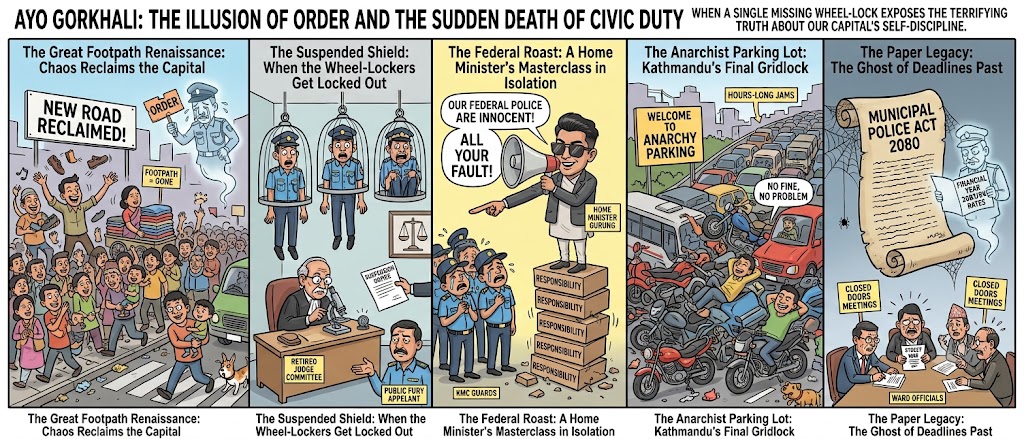
Ayo Gorkhali! The ferocious roar of Kathmandu’s municipal police has dissolved into an absolute, terrified silence. Following the tragic self-immolation of Ganesh Nepali after a routine wheel-lock dispute at the Passport Department, the city’s frontline warriors have beat a hasty retreat. New Road, Sundhara, and Baneshwor—once pristine, orderly, and aggressively cleared under the sweeping decrees of the previous administration—have instantaneously descended back into glorious, unchecked chaos.
Footpath vendors have triumphantly recaptured their lost empires, carpeting the sidewalks with clothes and shoes, forcing pedestrians to bravely battle moving traffic on the main asphalt. It is a spectacular victory for free-market anarchy, proving that our collective "civic sense" is merely an illusion that evaporates the very second a uniform disappears from the street corner.
The Suspended Shield: When the Wheel-Lockers Get Locked Out
In a frantic bid to appease public fury, a swift 9-point agreement between the federal government and the victim's family has effectively thrown the municipal police under the nearest moving safari bus. The deal dictates that the frontline officers involved in the fateful altercation are to be immediately suspended, waiting for a retired judge’s committee to hand down their fate.
Naturally, the remaining city police are now suffering from a severe crisis of morale, their hands shaking at the very sight of an illegally parked scooter. Why risk physical assault or career termination for a low-paying municipal gig when you can comfortably park yourself in the shade? Yet, there is a flicker of hope that this harsh operational pause will finally force the municipality to craft a security protocol that relies on structural training rather than unchecked aggression.
The Federal Roast: A Home Minister’s Masterclass in Isolation
Home Minister Sudhan Gurung stood tall at the parliament rostrum and delivered a masterpiece of political escapism, explicitly assuring the nation that federal police had absolutely nothing to do with the wheel-locking incident. By pointing his finger squarely at the Kathmandu Metropolitan City (KMC) force, the federal administration successfully isolated the local guards, treating them like an embarrassing stepchild rather than a partner in security.
This political abandonment has deeply wounded KMC officials, who suddenly realized that federal "coordination" only exists when sharing praise, never when distributing blame. Despite the icy chill between the two tiers of government, this public fallout exposes the desperate need for unified governance. True optimism lies in the fact that this disaster will force the central and local authorities to finally talk to each other instead of fighting through media microphones.
The Anarchist Parking Lot: Kathmandu’s Final Gridlock
With the city police safely hiding indoors, Kathmandu’s drivers have joyfully embraced their new constitutional right to park absolutely anywhere they please. The terrifying fear of the dreaded wheel-lock has vanished, transforming "No Parking" zones into permanent, sprawling exhibition centers for randomly abandoned motorcycles. Traffic police officers now stand helplessly at major intersections, watching hours-long jams unfold as roads shrink to the width of a standard footpath. The physical and mental agony of ordinary commuters has reached an all-time high, turning a simple cross-town drive into a multi-hour spiritual pilgrimage.
However, as the gridlock paralyzes the city's economic heart, it serves as a powerful, unavoidable reminder to the public that true civic sense shouldn't require a threat of a fine. The current mess is the dark catalyst needed to spark a mutual respect between citizens and local laws.
The Paper Legacy: The Ghost of Deadlines Past
Every fine, penalty, and aggressive clearing operation currently halting the city wasn't born out of thin air; they are the legal ghosts of the ambitious mayoral policies passed in recent years. The Municipal Police Act of 2080 and the stringent financial penalty structures passed in Shrawan 2082 were designed to whip Kathmandu into a clean, European-style utopia. Even in this transitional phase, the upcoming financial year 2083/84 rates are scheduled to take effect automatically under the autonomous powers granted by the constitution.
Ward officials are currently holding intense, informal meetings behind closed doors to figure out how to enforce these laws without triggering an all-out street war. The ultimate hope is that Kathmandu will survive this transitional identity crisis, evolving past personal cults of personality into a mature, institutional democracy where rules outlive the politicians who wrote them.
Jai Nepal!