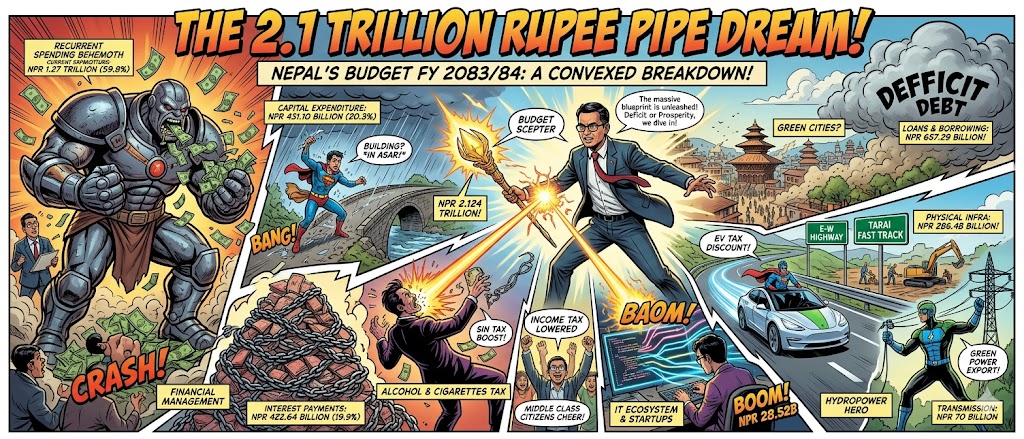
The Finance Minister just unveiled a 2.1-trillion-rupee economic blueprint that reads like a wild, late-night science fiction script written by a hyper-caffeinated optimist. In a brilliant display of economic acrobatics, the government has decided to fund its grand visions by swiping a national credit card with a deficit so deep it could swallow the Himalayas.
It’s a beautifully unhinged masterpiece where we are actively lowering income taxes while praying that taxing your evening beer will somehow pay off our massive international debts. So, buckle up and grab your QR codes, because we are about to dive into how the state plans to aggressively spend money it doesn't actually have.
The Macro Comedy (The Numbers)
Finance Minister Dr. Swarnim Wagle stood before the joint session of Parliament and unleashed a massive, history-making monster of a budget totaling NPR 2.124 Trillion (that’s 21 Kharba, 24 Arba, and 34 Crore for the traditionalists). This is a mind-melting 25.2% jump from last year’s revised estimates, demonstrating that when the state is in economic survival mode, its favorite strategy is to swipe a credit card with an infinite limit.
Where is this mountain of paper going? The absolute lion's share—a staggering NPR 1.270 Trillion (59.8%)—is earmarked for Recurrent Expenditure. This is the structural black hole of the state, ensuring that our gargantuan army of civil servants, ministries, and regional bureaucrats keep receiving their salaries, fuel allowances, and subsidized tea. To sweeten the deal, civil servants are getting a 10% base scale salary hike and a 10% performance incentive allowance. This comes after four years of wage freezes during which consumer prices rose by 17.3%, meaning the state is essentially paying them a little more to watch inflation eat their purchasing power anyway.
Meanwhile, Capital Expenditure—the mythical fund that is actually supposed to build schools, hospitals, and national wealth—stagnates at NPR 431.10 Billion (20.3%). History tells us this money will sit completely untouched until the frantic, torrential downpours of Asar (June/July), at which point it will be aggressively spent in a 30-day frenzy of highly questionable construction. The remaining NPR 422.64 Billion (19.9%) goes directly into Financial Management, which is a polite bureaucratic euphemism for paying back the compounding interest on the immense national debt we have accumulated over decades of doing exactly this.
To fund this massive bill, Dr. Wagle hopes to collect NPR 1.405 Trillion from domestic taxes and non-tax revenue, plus NPR 61.74 Billion in foreign grants from generous international neighbors who still feel bad for us. This leaves a massive NPR 657.29 Billion deficit. The government plans to fix this yawning gap by taking out NPR 247.28 Billion in foreign loans and borrowing another NPR 410 Billion domestically. The punchline? We have to pay back NPR 245.89 Billion of domestic debt this exact same year, making the entire exercise an elaborate, circular game of fiscal hot potato.
Ministry Wealth Distribution: Who Got Fed?
The Ministry of Physical Infrastructure and Transport walked away as the undisputed heavyweight champion of the budget, pulling in a record-shattering NPR 286.48 Billion for roads and urban development. The government intends to blacktop 1,000 kilometers of road and build 275 bridges this year. The East-West Highway leads the charge with NPR 37.46 Billion, followed closely by the Tarai-Madhesh Fast Track at NPR 17.64 Billion. In a brilliant display of self-aware comedy, the ministry also allocated a distinct NPR 3.17 Billion explicitly for landslide clearance on highways. They are effectively building roads with one hand and holding a shovel to dig them out of the mud with the other.
The Ministry of Energy, Water Resources, and Irrigation secured a massive power trip of NPR 85.54 Billion for energy generation, alongside NPR 70 Billion dedicated solely to completing transmission lines and substations. The grand plan is to add 1,040 Megawatts of new capacity (670 MW from hydro, 370 MW from solar) to bring Nepal’s total capacity to 5,535 MW. We are officially producing enough electricity to illuminate a small European nation, yet a mild, passing breeze in Kathmandu will still cause the local transformer to explode, plunging entire neighborhoods into romantic, candle-lit darkness.
The Ministry of Agriculture and Livestock Development received a major boost, including a massive NPR 32.46 Billion just for chemical fertilizer procurement. To prevent the annual, tragic comedy of farmers queuing for miles while their crops wither, the budget introduces a "seasonal calendar" for distribution. Additionally, farmers get an 80% premium subsidy on crop insurance, which is fantastic news, assuming the insurance claim forms aren't lost in a filing cabinet somewhere in Singha Durbar.
Sins, Software, and Swiping: The New Tax Codes
-
The Vice Tax Escalation (Alcohol & Cigarettes): If you plan on coping with this economy by drinking or smoking, the government expects you to pay heavily for the privilege. Excise duties on alcohol, beer, and cigarettes have been aggressively hiked yet again. The state views your liver and lungs as reliable, recession-proof revenue streams.
-
The Tax Simplification Mirage: On the bright side, excise duty has been completely abolished across 360 categories of goods, and chaotic extra levies have been consolidated into a singular "Green Levy" at customs.
-
Income Tax Reductions: In a rare move of genuine mercy, personal income tax thresholds and rates have been subtly adjusted downwards. The government has realized that if they keep taxing the middle class at extortionate rates, the entire demographic will simply board a one-way flight to Australia, leaving no one behind to pay taxes at all.
-
The Digital Wallet Discount: To completely eliminate the informal cash economy (and keep an eye on your spending), the government has reinforced tax discounts and removed VAT friction on digital payment systems. Swiping a QR code is now officially patriotic.
The Uncomfortable Tragicomedies
The budget proudly allocates NPR 28.52 Billion for a "nationwide road maintenance campaign." This is the formal, legalized branding of Asare Bikas. Every citizen knows the routine: the roads will be meticulously dug up and re-paved during the heaviest monsoon rains of July, ensuring the new asphalt liquefies and flows into the river system within forty-eight hours.
Similarly, NPR 4.19 Billion is dedicated to "greening major cities." In Kathmandu, where the air quality regularly rivals an industrial exhaust pipe, this fund will likely manifest as a few dozen potted trees placed along the ring road, bravely attempting to filter out massive clouds of dust and diesel fumes.
The Unreasonable Glimmer of Hope
Despite the layers of structural irony, Dr. Swarnim Wagle’s budget contains a legitimate, modern economic vision. The budget aggressively prioritizes the IT and Startup Ecosystem, heavily backing digital services, tech hubs, and software export frameworks. The state has finally acknowledged that young Nepali developers selling code to US and European companies are keeping the country’s foreign exchange reserves alive. By reducing bureaucratic friction for tech startups and protecting intellectual property, this budget actually builds a launchpad for the digital generation.
Furthermore, if the NPR 70 Billion transmission line investment succeeds, Nepal firmly transitions into a highly profitable green energy exporter to India and Bangladesh. We are slowly moving away from relying purely on remittance money sent home by migrant workers, and moving toward a future where we export clean, raw power. It is an incredibly ambitious blueprint. If our institutions can manage to execute even half of it without drowning it in red tape, Nepal might just stumble into a prosperous future by accident.
Jai Nepal!