Pull up a chair, grab a glass of aila—or the strongest chiya if you’re driving—and let’s talk about the Rato Machindranath Jatra. If you think your morning commute in Kathmandu is a struggle, you haven’t seen a 60-foot tall, leafy wooden skyscraper being dragged through the mud by a mob of screaming, muscle-bound youths. This isn't just a festival; it’s Nepal’s longest-running soap opera, a celestial rain-dance, and the ultimate test of Gorkhali suspension systems.
The Chariot: A 60-Foot Juggernaut
First, let’s talk about the Rath. This thing is a masterpiece of "Gorkhali Engineering"—meaning it’s held together by cane, wood, and a whole lot of prayer. There are no nails, no blueprints from Germany, and zero safety ratings. It’s a towering spire of greenery that looks like it belongs in an Indiana Jones movie.
When this beast starts rolling through the narrow streets of Patan, the buildings don't just look on; they lean back in terror. Pulling this chariot is a full-contact sport. You’ve got hundreds of people on the ropes, yelling "Haisey! Haise!" while the wheels—massive wooden discs—threaten to flatten anything in their path. If the chariot tilts, the crowd gasps; if it crashes into a house, it’s just "divine intervention" and a very expensive renovation project.
The Legend: A Gorkhali "Rescue Mission"
Why do we do this? Because back in the day, a cranky sage named Gorakhnath (yes, our namesake!) got annoyed and sat on the nine rain-clouds like they were sofa cushions, causing a 12-year drought. In typical Gorkhali fashion, we didn't just ask nicely for rain. A team consisting of a King, a priest, and a humble farmer trekked all the way to Assam to "kidnap" (or politely invite) Machindranath—Gorakhnath’s teacher.
When the teacher arrived, the student had to stand up to show respect, the clouds escaped, and boom—rain. We’ve been celebrating this successful "diplomatic mission" for over 1,300 years. It’s the original Gorkhali "Search and Rescue" operation.
The Bhoto Jatra: The Ultimate "Lost and Found"
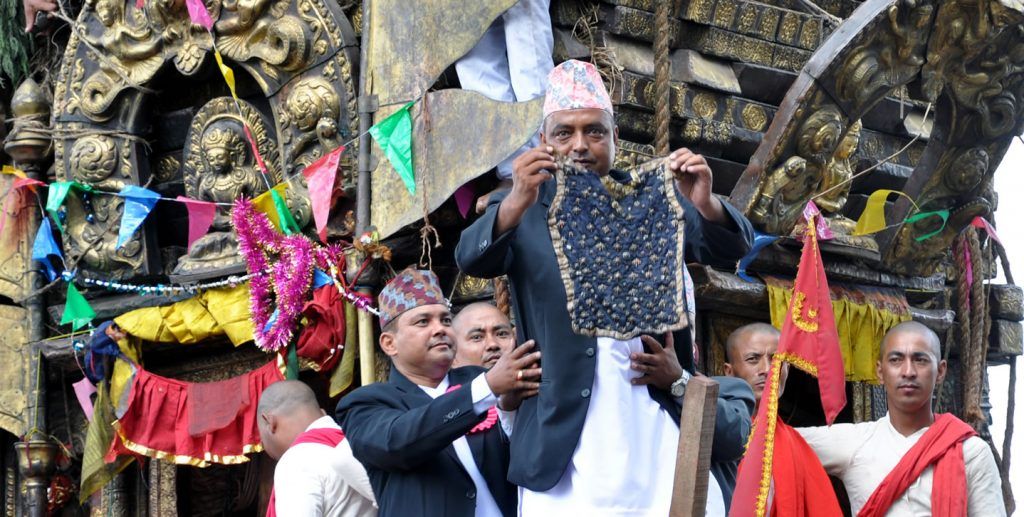
The festival ends with the Bhoto Jatra, which is basically the world’s most famous case of disputed property. Legend says a farmer and a Nagaraja (Serpent King) got into a tiff over a diamond-encrusted vest (the Bhoto). Since they couldn't settle it, they gave it to Machindranath for safekeeping.
Every year, a government official holds the vest up from the chariot four times, shouting, "Whose is this?" No one ever claims it—probably because they’re afraid of the tax implications in 2026—so we put it back in the box and try again next year. It’s the ultimate Gorkhali flex: having a vest so expensive that nobody dares to own it.
The Vibe: Grit, Grace, and Glitches
The energy in Patan during this time is electric. You’ve got the Gubhaju priests maintaining ancient rituals with calm dignity, while three feet away, a Gen-Z kid in a "Balen" t-shirt is trying to livestream the chariot's progress on 4G. It’s where the 7th century meets the 21st.
Rato Machindranath isn't just about asking for rain; it’s about the collective sweat of the community. It’s about the guthi members who have kept this tradition alive through earthquakes, blockades, and political upheavals. It’s the Gorkhali spirit in its purest form: stubborn, communal, and slightly chaotic.
So, if you see the chariot stuck in the mud at Gabahal, don't just take a selfie. Put your hand on the rope. Feel the strain. Because when that rain finally falls, you’ll know you didn't just watch history—you helped pull it.
image credit: LandNepal