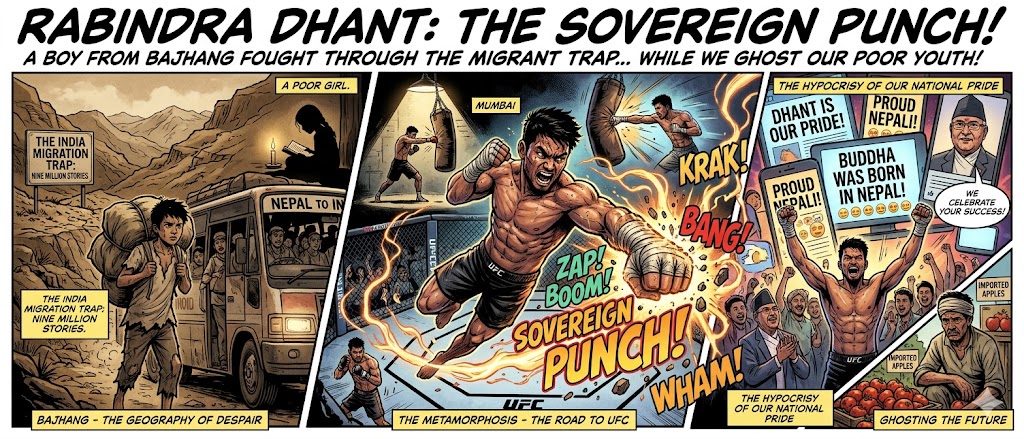
Before we flooded social media with proud emojis and conveniently claimed his historic victory as a collective national achievement, Rabindra Dhant was just another invisible statistic slipping across the open border into India. His jaw-dropping rise from the forgotten, dry dirt of Bajhang to the elite global cage of the UFC wasn't fueled by sports ministries or state funding; it was forged in the exhausting daily grind of an Indian migrant worker.
It is a classic, beautifully brutal tale of raw discipline punching through systemic neglect, serving as a harsh mirror to a nation that loves to celebrate international trophies but refuses to buy its own farmers' produce. So, let’s peel back the layers of our loud, hypocritical patriotism and look at what it actually takes for a rural kid to survive the system and conquer the world entirely on his own merit.
The Geography of Despair: Growing Up in Bajhang
If you want to understand the true meaning of structural neglect, take a long, bumpy look at Bajhang. It is a stunningly beautiful district in the Far-West where the mountains are majestic, the soil is dry, and the state’s presence is as real as a politician's election promise. For families like Rabindra Dhant’s, poverty isn’t a concept you debate over a corporate latte in Kathmandu; it is a permanent house guest that dictates every single meal.
In these rural stretches, survival doesn't depend on the federal budget or regional development plans. It depends on a one-way ticket across the border, because when your belly is empty, the breathtaking scenery of your homeland loses its charm remarkably fast.
The Classic Nepali Transit: The India Migration Trap
Like millions of youth from the Far-Western region, Rabindra’s journey didn't begin in a high-tech training facility; it began on the crowded night buses to India. For generations, our primary economic export hasn't been herbs, electricity, or handicrafts—it has been our young men, sent to work as security guards, kitchen hands, and laborers under the scorching sun across the border.
Dhant spent years grinding away in India, enduring the quiet humiliation of the migrant worker life, where you sweat profusely for a currency that isn't yours just to send home a few thousand rupees to pay off a local moneylender. His hands were calloused long before he ever wrapped them in athletic tape, shaped by a brutal daily routine where rest was a luxury he simply couldn't afford.
The Cage, the Discipline, and the Road to UFC
But while the migration trap breaks most spirits, it somehow forged Rabindra’s into steel. Fueled by a terrifying level of discipline and a quiet determination that could cut through solid rock, he turned his anger into technique, trading the exhaustion of manual labor for the calculated violence of the MMA cage.
His relentless grind eventually propelled him out of the shadows and straight into the "Road to UFC" tournament, where he recently secured a historic, jaw-dropping victory. Suddenly, the boy from the forgotten corners of Bajhang was standing on a global stage, proving that a diet of pure struggle can produce world-class fighters capable of dismantling opponents who had millions of dollars in corporate sponsorships.
The Hypocrisy of Our National Pride
The moment the referee raised Rabindra’s hand, the collective Nepali internet immediately went into a state of hysterical national pride. Suddenly, every politician, influencer, and keyboard warrior was claiming his victory, plastering his face on social media headers to flex our collective patriotism. But let's be painfully honest: we love celebrating the final victory, but we absolutely despise funding the messy, invisible struggle that comes before it.
We scream "Buddha was born in Nepal" and "Dhant is our pride," but we didn't chip in a single rupee for his training gear when he was starving across the border, nor do we care about the thousands of other young athletes currently sleeping on gym floors hoping for a break.
Buying Chinese Apples While Our Own Starve
This selective blindness isn't just limited to sports; it is our entire national personality. We weep for the poor girl in Dolpa or Madhesh who can't afford a single notebook for her basic education, yet we happily vote for leaders who build multi-million rupee view-towers instead of functional rural schools. We claim to love our rural communities, but our local markets are proudly flooded with imported Indian mangoes and pristine Chinese apples, while our own struggling farmers watch their local harvests rot in the fields because domestic transportation costs more than international shipping.
We are a country that happily outsources its survival and buys its nutrition from neighbors, only to demand that our poorest citizens somehow bring back international trophies to make us feel good about ourselves.
The Unreasonable Glimmer of Hope
Yet, despite our systemic laziness and collective hypocrisy, Rabindra Dhant’s rise offers a terrifyingly beautiful glimmer of hope for the future. He proves that the margins of this country are not empty; they are packed with raw, unpolished, and completely unstoppable talent.
If a kid from the forgotten valleys of Bajhang can punch his way through the migration trap and stand at the gates of the UFC entirely on his own merit, then the institutional rot of Singh Durbar cannot hold this generation back forever. The youth are no longer waiting for the state to build the road; they are simply learning how to fly right over the mountains.
Jai Nepal!