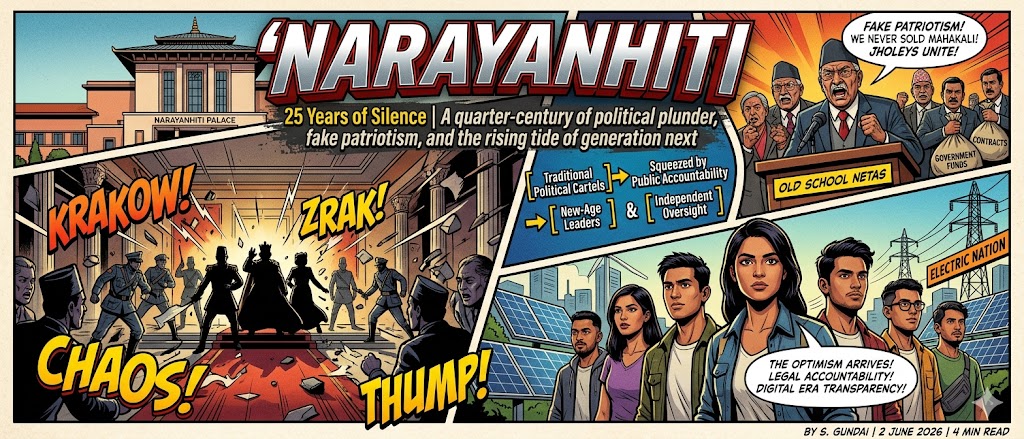
Twenty-five years ago today, the ultimate family dinner went horribly wrong. On June 2, 2001, Narayanhiti Palace hosted a gathering that concluded not with dessert, but with an automatic weapon clearing out the core of the Nepalese monarchy.
A quarter of a century has passed, and the official explanation remains unchanged: a love-struck Crown Prince, supposedly frustrated by a matrimonial disagreement, decided to liquidate his entire lineage before turning the barrel on himself. It is a narrative so perfectly wrapped in a bow that absolutely nobody in the country actually believes it.
The tragedy remains a profoundly heartbreaking scar on the collective memory of the nation. It was the night a nation lost its anchoring identity, transitioning from a flawed but stable traditional kingdom into a chaotic laboratory for political experiments. Over the next two decades, the true horror unfolded not inside the palace walls, but across every government ministry, cooperative board, and public office in the country.
The Great Republican Loot
The transition from a single royal family to several hundred local dynastic politicians did exactly what anyone with a basic understanding of human greed would expect. The old system was replaced by a decentralized syndicate of plunder. Over the past twenty-five years, the country has been methodically hollowed out by a revolving door of aging leaders and their thousands of fiercely loyal "jholeys"—the ultimate political sycophants.
While ordinary citizens struggled through economic stagnation, this chosen class of party cadres grew astonishingly wealthy. They made their riches by monopolizing lucrative government contracts, siphoning public development funds, and running cooperative scams that wiped out the life savings of thousands of families. It became a highly profitable industry: praise the party chief on social media, wave a plastic flag, and receive a taxpayer-funded construction tender in return.
The tragic consequence of this system is visible at the Tribhuvan International Airport every single afternoon. Millions of our brightest minds and physically capable youth have been forced to queue up for low-wage labor in the Gulf or East Asia simply because domestic opportunities were reserved for well-connected party sycophants.
The Loud Symphony of Fake Patriotism
To distract from this mass migration and economic rot, our old-school political veterans have mastered the art of fake patriotism. They regularly step up to the podium, veins bulging and lungs bursting, to deliver fiery speeches about national sovereignty and external threats.
The sheer hypocrisy is breathtaking. These are the exact same individuals who historically signed away monumental natural assets, like the Mahakali river system, for absolute pennies while ensuring their personal futures remained perfectly secure. If true patriotism were measured by infrastructure built, jobs created, or rivers protected, our leadership would be facing a permanent national eviction. Instead, they wrap themselves in the national flag to hide the grease stains of institutional bribery.
A New Beginning Amidst the Ruins
Yet, twenty-five years after the royal tragedy, the national mood is subtly shifting from despair to collective defiance. A genuine turning point has arrived, and for the first time in a generation, selective optimism is replacing habitual cynicism.
The younger generation is no longer content with waiting for crumbs from the old political high command. They are bypassing the traditional party structures entirely, using digital transparency, legal accountability, and raw voting power to dismantle the old cartels. While the aging elite continues to shout their outdated slogans to shrinking crowds, the country is quietly moving toward a fully electric, modern future.
We may never get the absolute, unfiltered truth about what transpired on that bloody June evening twenty-five years ago, but we are finally building a nation where nobody can treat the public treasury like their personal inheritance.
Jai Nepal!