Good Morning Nepal!
Happy Buddha Jayanti & Ubhauli Parva & Majdoor Diwas!
1. The Ordinance of Expulsion: Clearing the Decks, Dictator-Style
Our RSP-led government, in an absolute masterclass of democratic "efficiency," has recommended an omnibus ordinance to President RCP that would amend 20 laws just so they can immediately fire every single political appointee made by previous administrations. The opposition is understandably screaming about "executive overreach," while the government maintains it's just removing pesky legal barriers so they can appoint their loyalists instead. This includes vaporizing the tenure of university officials and dissolving development committees, which is just natural government evolution, we’re sure. It seems the best way to run a country is apparently by bypassing that boring, inconvenient institution known as Parliament.
2. TU Officials Accept the Inevitable: Preemptive Pink Slips
Proving they can read a room—or at least an imminent government purge—the Vice-Chancellor, Dean, and Registrar of Tribhuvan University all submitted their resignations today before the above-mentioned ordinance could formally kick them out. They cited a noble desire to "clear the path" for the new government, which is bureaucratic speak for "I’d rather quit than be publicly humiliated by an RSP memo." These Oli-era relics knew their time was up, especially as the government is eyeing 1,200 total dismissals across the board. We can only assume the job market for "recently purged public official" is about to become very competitive.
3. Rs 11 Billion for Eight Lanes: Let’s Hope We Can Find a Driver
Nepal and China officially signed a landmark Rs11 billion grant agreement to finally widen the Kathmandu Ring Road stretch from Kalanki to Basundhara into an impressive eight lanes of potential gridlock. The project, which also includes actual pedestrian bridges and streetlights (what luxury!), is touted to ease urban traffic and boost north-south connectivity. Minister Sunil Lamsal called it a top priority, which is encouraging considering how well our existing roads are maintained. Now we just have to wait for the construction to inevitably shut down the entire area for the next five years.
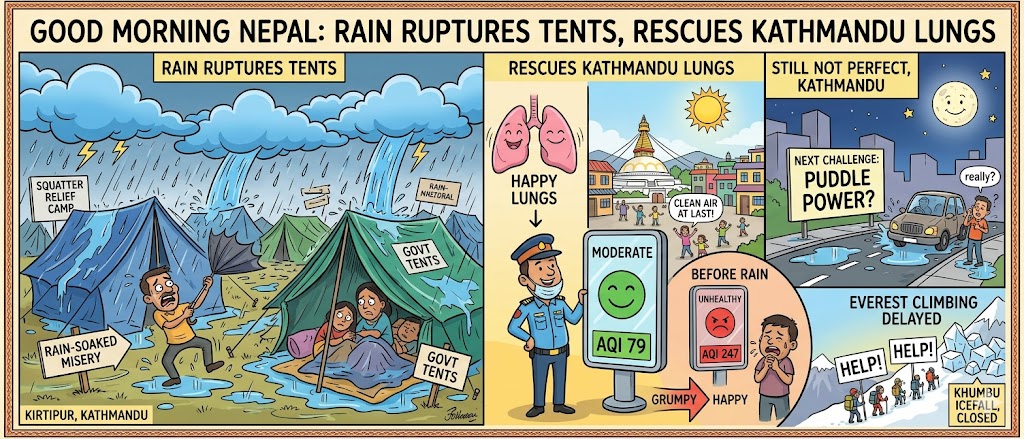
4. Evicted Squatters Discover Rain: The Government Tents are Water-Resistant (We Think)
Hundreds of evicted squatter families, currently living in temporary tents in Kirtipur, got a crash course in monsoon preparedness when Tuesday's rain soaked all their belongings and bedding. The government, in its unparalleled compassion, provided some tents but apparently forgot about food options, infant care, or the minor issue of severe weather making life unbearable. One mother noted that, unlike this camp where they get porridge and biscuits, they actually had choice back in their illegal shanties—how inconveniently ungrateful. resettlement remains a distant, blurry hope, but at least they're getting lots of fresh air.
5. Surprise! Breathing is (Temporarily) Less Fatal in Kathmandu
In a stunning twist that authorities definitely didn’t see coming, Kathmandu's air quality has improved from its usual ranking of "literally the worst in the world" to a slightly less dangerous 26th globally. The Department of Environment claims this is thanks to "sufficient rainfall" and "strong winds," which are technical terms for "weather we had absolutely nothing to do with but will take credit for." The AQI is now 'moderate,' meaning you only risk some long-term lung damage today, which is basically a clean air triumph in this valley. Let's all breathe slightly deeper before the sun comes out and the smog inevitably returns.
6. Painkillers Banned to Save Vultures: Biodiversity Wins (For Now)
The government has finally banned three veterinary painkillers that were scientifically proven to wipe out the vulture population by giving them massive organ failure when they ate decaying carcasses. Conservationists are hailing this as a biodiversity victory, because Apparently, having healthy populations of birds that dispose of rotten meat is essential to prevent other diseases, which sounds suspiciously logical. Distributors get six months to sell their poison stash before switching to "vulture-safe" stuff, because we wouldn’t want a veterinary supplier to lose money just to save an entire species.
7. School Bus Flips, Driver Flips (His Career)
A school bus in Jhapa district decided to execute a surprise acrobatic maneuver and overturn after hitting a motorcycle, injuring thirteen students, because standard transportation just isn't exciting enough. Eleven kids were hospitalized in Birtamod, because nothing says "quality education" like a traumatic vehicle accident. The motorcyclist also got banged up, but the true MVP is the bus driver, who immediately "absconded" from the scene, presumably to start a new career in not driving a school bus. Police are investigating, because that’s what you do when your driver literally runs away from his problems.
8. Diaspora Keeps Up the Tradition: YouTube Dancers, Unite!
On the Baisakh full moon, the Nepali diaspora from Queens to Reading gathered in community halls to enthusiastically dance the Sakela Silli, because nothing says "I miss the motherland" like following a YouTube dance tutorial with a bad internet connection. This Kirat migration festival, celebrating the spirit of the soil, saw dhol drums "louder than the traffic" in Gangtok, proving that Gorkhali volume knows no borders. The goal, as always, is to mimic birds and planting, while desperately trying not to trip over your fellow dancer’s feet, which is significantly harder after a few celebratory chhyangs.
9. Everest Summit Dreams Remain Just That: The Ice Doctors Prescribe "Patience"
Despite it being spring, standard summit season, the Khumbu Icefall remains stubbornly closed for business because "safe routes" have conveniently failed to appear this year. The Sherpa team responsible, known as "Icefall Doctors," are currently telling climbers to "wait for the ice wall to melt," which is essentially like saying "sit tight while the massive glacier tries to kill you more creatively." Expediton organizers are actually being cautious this year, perhaps because last year's death count was a bit too high, even for Everest's lethal standards. This reminds everyone that the world's highest peak is still significantly more terrifying than your boss.