Good Morning Nepal!
1. The Constitutional Chessboard
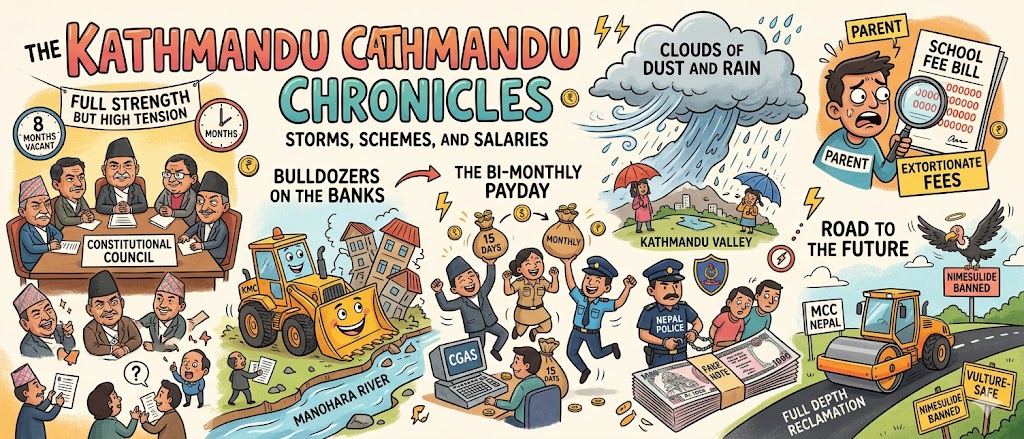
The Constitutional Council has finally regained its full strength after an eight-month vacancy, signaling a major push for administrative stability. Prime Minister Balen Shah’s government has moved swiftly to fill these high-level seats, aiming to clear a massive backlog of judicial and bureaucratic appointments that had stalled for nearly a year.
However, the move has sparked immediate friction with the opposition, who claim the sudden use of ordinances to bypass regular parliamentary sessions is a reach for executive overreach. As the Council prepares to vet new leaders for critical bodies, the political temperature in Kathmandu is rising as fast as the afternoon humidity.
2. Bulldozers on the Banks
The eviction drive in the Manohara settlements continued today as municipal authorities deployed bulldozers to clear unauthorized riverbank structures. Over 800 households have been identified in this latest sweep, which the Kathmandu Metropolitan City describes as a necessary step to restore the capital’s river corridors and mitigate monsoon flooding risks.
Displaced families, many of whom have lived on the land for decades, have begun registering with the government as landless squatters in hopes of resettlement. While the city promises a cleaner urban landscape, critics argue the rapid demolition ignores due process and leaves the city’s most vulnerable without a safety net during the unpredictable spring storms.
3. The Bi-Monthly Payday Experiment
Finance Minister Swarnim Wagle officially inaugurated a pilot project yesterday that transitions government employees to a 15-day salary cycle. Using the Computerized Government Accounting System (CGAS), federal civil servants at the Ministry of Finance were the first to receive their bi-monthly checks, a move intended to boost liquidity and consumer spending.
The government believes that more frequent pay cycles will help lower-income employees manage their household budgets better and stimulate the local retail economy. If the pilot proves successful in the coming months, the program is slated to expand to all federal and provincial civil servants across the country.
4. Clouds of Dust and Rain
A massive dust storm and heavy rainfall swept through the Kathmandu Valley late yesterday afternoon, plunging the city into darkness by 5:00 PM. The sudden weather shift followed a week of "very unhealthy" air quality levels, providing a much-needed, albeit chaotic, temporary reprieve from the choking smog that has plagued the capital.
While the rain helped clear the air, the heavy winds caused significant disruption, damaging temporary shelters in resettlement areas and affecting winter crops in the surrounding districts. The Meteorological Forecasting Division warns that these pre-monsoon "thunder-squalls" are likely to persist, urging residents to stay alert for sudden flash floods.
5. The Battle for the School Bag
Parents across Nepal flooded the Ministry of Education with complaints today over what they describe as "extortionate" private school fees. Despite government directives to refund illegal admission and annual charges, many institutions have reportedly refused to comply, leading to a surge of calls to the newly established central help desk.
The Ministry has threatened strict action against schools that ignore the fee caps, but parents are demanding a direct central intervention rather than leaving it to local levels. The standoff comes as the new academic session begins, leaving many families caught between quality education and financial ruin.
6. The "Fake Note" Sting
Nepal Police announced a major breakthrough today after arresting six individuals involved in a sophisticated fraud scheme that utilized Rs 20 million in counterfeit banknotes. The gang reportedly used bundles of "staged" money to build trust with unsuspecting business owners before disappearing with genuine cash and high-value assets.
This arrest follows a string of reports regarding fake currency circulating in major commercial hubs like New Road and Banepa. Authorities have warned the public to be extra vigilant during large cash transactions, as the counterfeiters have become increasingly skilled at mimicking the security features of the latest banknote series.
7. Roads to the Future
Upgrading works on the Dhankhola–Lamahi road section officially began today under the MCC Nepal Compact, introducing advanced "Full Depth Reclamation" technology to Nepal’s highways. This project is a centerpiece of the government’s plan to improve East-West connectivity and reduce the high cost of goods transport caused by aging infrastructure.
In a related move, the government proposed a new "Transport Bill" today designed to protect citizens who assist road accident victims. By removing legal hurdles for "Good Samaritans," the bill aims to ensure that those injured in Nepal’s frequent traffic mishaps receive medical attention during the critical "golden hour" after a crash.
8. Vultures over Painkillers
The government has officially banned three common veterinary painkillers—nimesulide, aceclofenac, and ketoprofen—after scientific studies linked them to the catastrophic decline of Nepal's vulture population. The drugs, used to treat livestock, prove fatal to vultures that scavenge on the carcasses, disrupting the natural ecosystem.
Distributors have been given a six-month grace period to phase out existing stocks and transition to "vulture-safe" alternatives like meloxicam. Conservationists have hailed the move as a landmark victory for biodiversity, noting that the return of healthy vulture populations is essential for preventing the spread of diseases from decaying animal remains.
9. The US-Nepal Cricket Clash
In a rain-hit encounter at Kirtipur yesterday, the Nepali national cricket team suffered a setback, falling to the USA in their latest League 2 match. Despite a promising start and a spirited fifty from Poddar, the match was eventually decided by the DLS method after heavy thunderstorms forced an early end to play.
Fans who braved the dust and rain at the TU Ground left disappointed, but the performance highlighted the growing competitive edge of the squad on the global stage. The team is now looking to regroup before their upcoming fixtures, with coaching staff emphasizing the need for better middle-order stability under pressure.