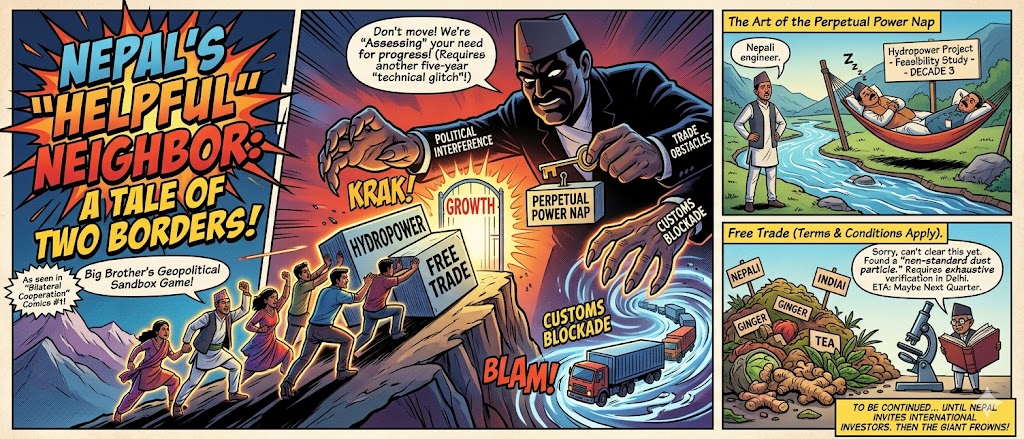
Fresh off the red carpet in New Delhi, the ruling Rastriya Swatantra Party (RSP) chief Rabi Lamichhane has landed in India for a high-profile five-day diplomatic charm offensive. With the traditional establishment in Kathmandu swept away and Prime Minister Balen Shah staying home to focus on domestic reforms, the burden of fixing a fundamentally dysfunctional neighborly dynamic has fallen squarely onto Rabi’s charismatic shoulders. For decades, Nepal's leaders have traveled south with bowls in hand, practically begging for validation from the mandarins of Chanakyapuri.
But with a massive democratic mandate behind him, Rabi has a historic opportunity to rewrite the script: to look the Indian establishment in the eye and explain that true partnership means being actual equals, not a muscular "Big Brother" who treats domestic Nepali politics like a regional boardroom game. If he can use his media-savvy grit to pivot the conversation from patronizing oversight to a genuine, respectful alliance, he might just teach New Delhi that cooperation is a two-way street—not a highway where India holds all the toll booths.
It is a universally acknowledged truth in South Asia that if you are a landlocked nation sandwiched between two giants, your domestic sovereignty is essentially a suggestions box that your southern neighbor routinely uses as a paperweight. Welcome to the geopolitical masterclass of the India-Nepal relationship, a beautiful, one-sided romance where New Delhi plays the role of the aggressively possessive partner who insists they "know what's best for you" while quietly changing the locks on your back door.
To understand this deep bond, one must look at how India gracefully masterminds the art of "bilateral cooperation." In New Delhi's eyes, helping Nepal with domestic politics is not interference; it is simply free micro-management. Whenever Kathmandu tries to draft a constitution, hold an election, or change a prime minister without getting the ritual stamp of approval from a specific office in Chanakyapuri, the atmosphere suddenly turns colder than a winter morning in Muktinath.
If Nepal makes an independent choice, India doesn’t throw a tantrum; they just coincidentally suffer a massive technical glitch at the customs border. Suddenly, cargo trucks carrying essential fuel and medicines are stuck in a mystical, bureaucratic twilight zone. It’s not a blockade, you see. It’s just a very intense, five-month-long vehicle inspection to ensure our safety. Naturally.
The Art of the Perpetual Power Nap
Nowhere is this generous partnership more evident than in the hydropower sector. Nepal possesses a staggering theoretical capacity for hydropower, but India has pioneered a brilliant strategy to harness this energy: the collect and conserve method. Indian firms enthusiastically scoop up generation and survey licenses for massive projects like the West Seti or Upper Karnali, and then perform a masterclass in aggressive relaxation.
These licenses are treated like vintage fine wine—meant to be stored in a dark cabinet for decades, untouched by actual construction. The goal isn't to build power plants; it’s to ensure no one else builds them either. If Nepal politely asks why no concrete has been poured since 2014, the response is a masterful combination of regulatory delays and strategic shrugs. Yet, the moment Nepal attempts to invite other international investors to look at the stagnant rivers, New Delhi experiences sudden heartburn, reminding everyone that cross-border electricity trade is strictly an exclusive, monogamous relationship.
Free Trade (Terms and Conditions Apply)
When it comes to the economy, the asymmetric hospitality is truly breathtaking. Nepal treats Indian businesses and citizens with ultimate neighborly warmth. You want to open a corporate branch, run a business, or stream millions of remittance rupees across an open border? Hunchha, hajur! Come right in, the doors are wide open.
However, when Nepal tries to send its own agricultural products or goods south, the free trade agreement suddenly develops a severe case of asthma. Nepali ginger, tea, and tomatoes are frequently stopped at the border for spontaneous, hyper-rigorous laboratory testing that takes just long enough for the produce to rot into a fine compost. It is a brilliant non-tariff barrier: death by a thousand phytosanitary certificates. The golden rule of cross-border trade dictates that what is yours is ours to regulate, and what is ours is too big for you to question.
Ultimately, Nepal remains trapped in a geopolitical sitcom where it provides the water, the open access, and the absolute hospitality, while India provides the roadblocks, the stalled infrastructure, and the constant reminders of who owns the transit routes. It is a flawless system. We make it incredibly easy for them to walk all over us, and in return, they ensure we never have enough electricity to see what they are doing in the dark. Ayo Gorkhali, indeed, but make sure you clear it with the border customs yard first.
Jai Nepal!