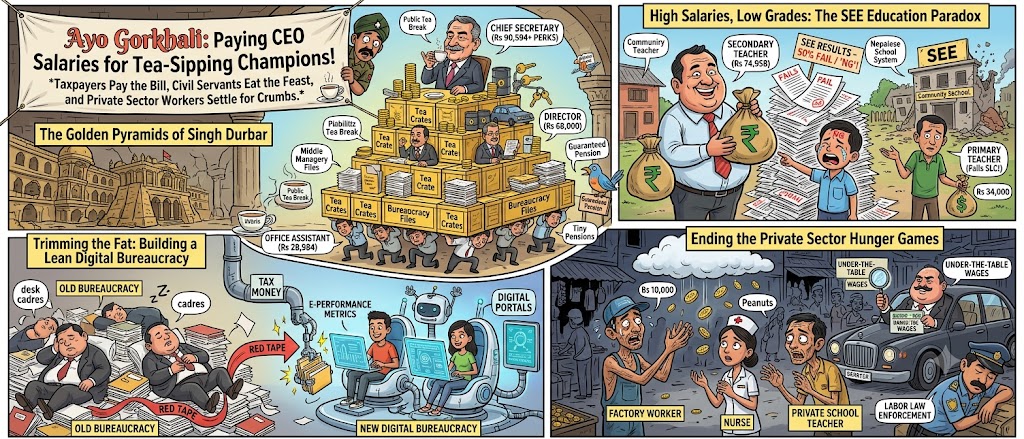
The government recently published its revised salary scale, reminding us all that public service is the ultimate lifetime lottery ticket. Sitting comfortably at the top of the food chain is the Chief Secretary, taking home Rs 90,594 a month alongside an array of state-funded perks, fuel allowances, and drivers. Way down at the bottom sit the office assistants earning Rs 28,984—still enjoying job security that private employees can only dream about in their wildest sleep.
While taxpayers grind through inflation to keep the lights on, our civil bureaucracy enjoys guaranteed pensions, annual increments, and immunity from accountability. The hierarchy remains intact: work hard in the private sector to fund someone else’s lifelong tea break.
High Salaries, Low Grades: The SEE Education Paradox
In a comedic masterpiece of government budgeting, community school secondary teachers now draw up to Rs 74,958 monthly, while even primary teachers who failed their own SLC back in the day pocket over Rs 34,000. Yet, year after year, over half of public school students fail their Secondary Education Examination (SEE), earning Non-Graded results that doom their higher education dreams.
We are effectively paying top-tier money for bottom-tier academic outcomes, rewarding failure with automatic grade raises and pension benefits. If a private business delivered a 50% defect rate every single season, it would go bankrupt in a week; in public education, it gets you a salary revision.
Trimming the Fat: Building a Lean Digital Bureaucracy
We cannot keep squandering millions of hard-earned taxpayer rupees simply to maintain a bloated army of paper-pushers and rubber-stamp operators. The solution is straightforward: digitize administrative workflows, replace redundant manual desks with automated portals, and link salary increments to verified performance metrics.
A lean, tech-driven government would drastically reduce the size of the civil service while paying actual high-performers what they deserve. Transitioning from paper files to digital infrastructure will cut red tape, minimize bribery opportunities, and stop using state coffers as an endless feeding trough for politically connected cadres.
Ending the Private Sector Hunger Games
While government workers sip free tea, the private sector remains a sweatshop where qualified nurses, factory workers, and private school teachers earn peanuts. Fresh nurses working 12-hour shifts in private hospitals often make less than an uneducated government peon, and private school teachers survive on under-the-table wages far below official minimum wage requirements.
The government must strictly enforce labor laws, impose hefty fines on non-compliant private employers, and mandate digital bank transfers for all wage payments to track wage theft. Hope lies in a system where pay reflects genuine effort and skill rather than whether you passed a civil service exam twenty years ago.