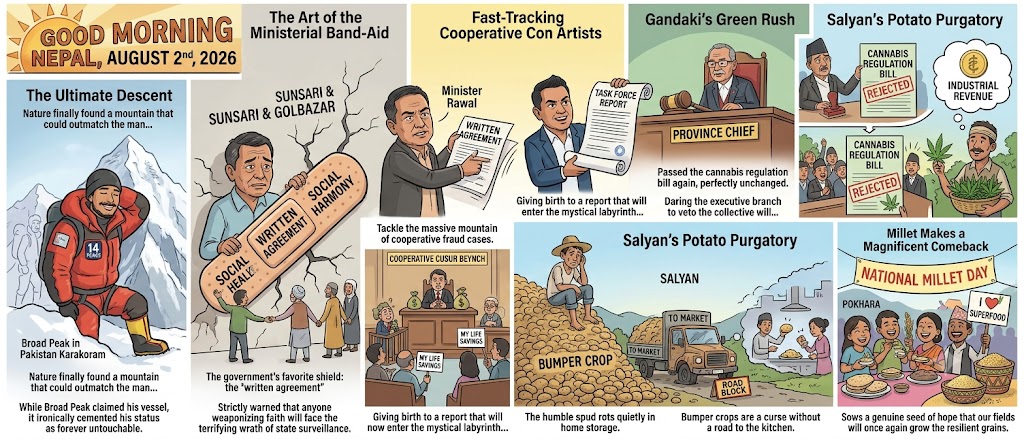
Good Morning, Nepal!
1. The Ultimate Descent of Nims Dai
Nature finally found a mountain that could outmatch the man who climbed fourteen of them in record time. While Broad Peak claimed the physical vessel of the legendary Nirmal Purja, it ironically cemented his status as forever untouchable by the mundane grips of aging or gravity. We comfort ourselves knowing he died doing what he loved, though we collectively wish he loved something a bit safer—like stamp collecting or golfing. May the snows of the Karakoram hold him gently, and may his indomitable spirit continue to remind us that humans can, for a brief moment, dance among the gods.
2. The Art of the Ministerial Band-Aid
Minister Sudan Gurung has successfully deployed the government’s favorite shield: the "written agreement," effectively putting a paper band-aid on the deep-seated fractures of Sunsari and Golbazar. We are strictly warned that anyone weaponizing faith will face the terrifying wrath of state surveillance, which historically functions with the speed of a dial-up internet connection. There is immense comfort in knowing our social harmony is now guarded by threats of strict legal action, a system famous for its flexible definitions of promptness. Yet, hope flickers that maybe this time, the ink on the contract actually binds hearts instead of just filling filing cabinets.
3. PM Balen’s Eulogy from the Cyber-Throne
Prime Minister Balen Shah took to Facebook to remind the nation that climbing is not merely about touching the sky, but a supreme expression of human endurance—and nothing screams ultimate endurance like surviving Nepali political commentary. His poetic tribute transformed a national tragedy into a philosophical treatise on sacrifice, proving that while he cannot stop avalanches, he can certainly craft a caption that moves mountains. We mourn the fallen heroes under the comfort of a leadership that values the aesthetics of grief as much as the metrics of governance. In the end, his words remind us that even when our brightest stars fall from the peaks, their courage remains etched immutably into the bedrock of our national pride.
4. Fast-Tracking the Cooperative Con Artists
In a shocking twist of bureaucratic agility, Minister Rawal has begged the Chief Justice for dedicated court benches to tackle the massive mountain of cooperative fraud cases before the culprits finish spending the money. The ministry actually formed a task force that finished its homework on time, giving birth to a report that will now enter the mystical labyrinth of the Supreme Court. We eagerly await the day these special courts open, providing a highly organized venue for victims to watch their life savings dissolve with legal precision. Still, there is a beautiful, naive hope that these dedicated benches might actually penalize a billionaire before the turn of the next century.
5. Bagmati Province Discovers the Concept of Real Estate
After a mere eight years of wandering in the administrative wilderness, the Bagmati Province government has bravely decided it deserves its own roof in Hetauda. They have finally initiated the sacred ritual of "managing forest areas," which is a polite governmental term for chopping down trees to plant concrete ministries. It turns out that a permanent capital requires actual buildings rather than just ambitious press releases and temporary leases. Hope springs eternal that once these walls are built, the efficiency of the politicians inside will miraculously rise to match the height of the architecture.
6. Gandaki’s Green Rush Defies the High Command
When the Province Chief tried to buzzkill the party by rejecting the cannabis regulation bill, the Gandaki Province Assembly simply passed it again, perfectly unchanged. It seems the lawmakers are entirely blunt about their intentions, proving that when it comes to industrial and medicinal weed, they are highly motivated to keep the high hopes of the agricultural sector alive. The bill now heads back to the top, daring the executive branch to veto the collective will of a parliament determined to monetize the hills. If nothing else, Nepal’s economy might finally find its high note in the very weeds we used to pull.
7. The Red Tape Strangulating the Hydropower Dream
Minister Biraj Bhakta Shrestha has boldly announced that the greatest threat to pulling electricity from our roaring rivers isn't engineering, but the absolute nightmare of land acquisition and inter-agency ghosting. It takes truly spectacular administrative talent to ensure that a project can survive raging floods but die entirely inside a dusty folder on a bureaucrat's desk. We are told that without fixing contract management, the nation will remain in the dark, which is excellent motivation for a country that has practically institutionalized candlelit romanticism. Yet, hearing a minister name the monster gives us hope that someone might finally unplug the bureaucracy and turn the lights back on.
8. Salyan’s Potato Purgatory
The farmers of Salyan have successfully produced a magnificent harvest of summer potatoes, only to realize that the market values their hard work at approximately zero rupees. As the spuds rot quietly in home storage or wait anxiously underground, the local economy learns the bitter lesson that bumper crops are a curse without a road to the kitchen. It is a masterclass in agricultural planning: teaching citizens how to grow food perfectly while keeping the distribution network entirely prehistoric. Let us hope these tubers hold out long enough for the government to remember that people eat potatoes, not promises.
9. Millet Makes a Magnificent Multimillion-Rupee Comeback
Pokhara recently hosted a grand festival to celebrate National Millet Day, proving that the humble, forgotten grain of our ancestors is excellent for photo-ops and nutritional slogans. The Pumdibhumdi Agriculture Cooperative spared no effort in reminding us that the food we used to look down upon as "poor man’s rice" is actually the superfood saving our future health. It is truly inspiring to see urbanites gather to praise rural crops, right before they go home to order a plate of imported white basmati rice. Nevertheless, the festival sows a genuine seed of hope that our fields will once again grow the resilient grains that sustained generations before the age of fast food.