Good Morning, Nepal!
1. The Prime Minister is Deeply Sensitive
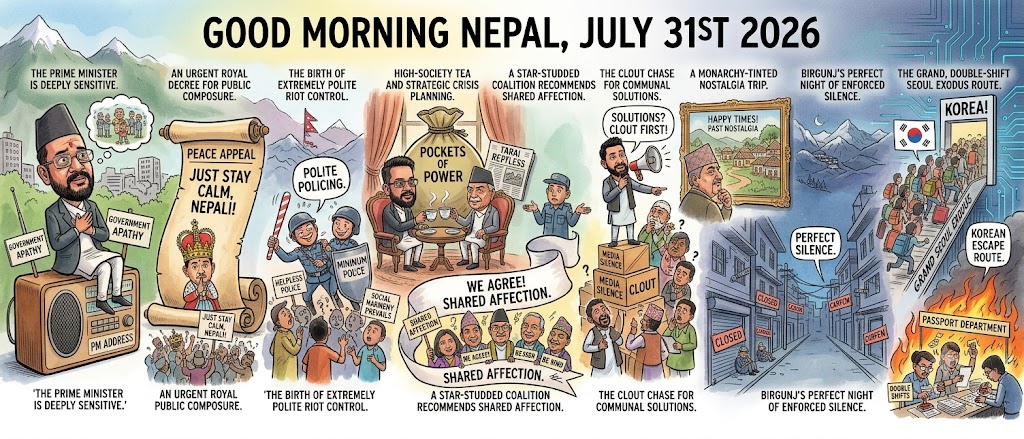
Prime Minister Balendra Shah hit the airwaves to solemnly declare that the government is fully sensitive to the recent volatile events in Sunsari and other districts. The official state address assured us that public safety and social harmony are being given the highest priority by the administration. It is deeply comforting to know that while regional tensions boil, the top office is actively watching the situation develop in real-time. This sudden burst of prime ministerial attention gives us a rare, optimistic glimmer that law and order might actually prevail.
2. An Urgent Royal Decree for Public Composure
In the second half of his grand address, PM Balen passionately urged the nation to maintain absolute peace, social harmony, and collective tolerance. He took a somber moment to pay heartfelt tributes to Jayaprakash Mehta, Omprakash Mehta, and Ganesh Yadav, who tragically lost their lives, while extending deep condolences to their grieving families. It turns out that asking a wounded nation to simply stay calm is the ultimate tool in the modern governance handbook. Yet, the official recognition of these losses offers a small beacon of hope that justice and healing are on the horizon.
3. The Birth of Extremely Polite Riot Control
In a masterclass of crisis management, the Police Headquarters canceled all active leaves for personnel and strictly ordered Tarai districts to employ "minimum force." Police Spokesperson DIG Abinarayan Kafle explained that officers are instructed to maximize dialogue, gently reasoning with furious mobs before even thinking about picking up a baton. There is something beautifully sarcastic about fighting civil unrest with polite conversation and institutional optimism. Still, the directive to avoid unnecessary violence brings a genuinely bright dawn of hope for human rights in the plains.
4. High-Society Tea and Strategic Crisis Planning
As the southern plains grew restless, PM Balen Shah swiftly marched over to Shital Niwas for an urgent, high-level summit with President Ramchandra Poudel. Insider sources confirm the duo focused heavily on the brewing communal friction, trying to decode the sudden spike in regional instability. Nothing projects iron-clad governance quite like the nation’s top two leaders holding a cozy strategy session over tea while the country waits for answers. Yet, seeing the executive and head of state working in perfect lockstep provides a comforting sign that a resolution is being actively forged.
5. A Star-Studded Coalition Recommends Shared Affection
Not to be outdone in the race for political relevance, a colorful coalition of Madhesh-centric parties issued a joint press release politely requesting everyone to just get along. The collective group—spanning JSP Nepal, Rastriya Mukti Party, Janamat Party, Rastriya Nirman Dal, and former CA member Ramkumar Sharma—mourned the Devanaganj tragedy and begged for restraint. It is truly remarkable how political factions that normally cannot agree on lunch can instantly unite to sign a beautifully worded piece of paper. This sudden display of regional solidarity gives the country a much-needed dose of optimism for cultural unity.
6. The Clout Chase for Communal Solutions
RSP Chairman Rabi Lamichhane swiftly jumped into the ring as well, holding marathon meetings with various Tarai-Madhesh leaders to brainstorm potential solutions. The discussions focused heavily on the rapidly evolving situation in the south, ensuring that no national crisis passes without a proper inter-party dialogue session. Watching the opposition actively hustle to mediate regional disputes provides a fine piece of political theater for the morning news. More importantly, it keeps the hope alive that democratic dialogue might actually solve real-world problems.
7. A Monarchy-Tinted Nostalgia Trip
Even former King Gyanendra Shah broke his silence, issuing a beautifully nostalgic decree reminding the populace that Nepalis have been happily loving each other since the dawn of time. His Thursday statement expressed deep concern over the eastern Tarai, emphasizing that our beautiful multi-ethnic and multi-religious fabric must never be torn apart by modern friction. It is wonderfully ironic to watch a deposed monarch lecture a federal republic on how to maintain national unity and peace. Still, the universal call for brotherhood across all political spectrums brings a warm, unifying hope to the morning air.
8. Birgunj’s Perfect Night of Enforced Silence
To ensure the good citizens of Parsa enjoyed a perfectly peaceful evening, the District Security Committee thoughtfully locked down Birgunj under a strict curfew. The prohibitory order ran from Thursday evening at 5 PM straight through to Friday morning at 6 PM, creating a neat perimeter from Pratima Chowk to the Shankaracharya Gate. There is a dark, beautiful sarcasm in the fact that the easiest way to guarantee public harmony is to legally forbid the public from stepping outside. Nonetheless, the swift action successfully kept the peace, offering a secure, incident-free night for the local population.
9. The Grand, Double-Shift Seoul Exodus Route
For those who prefer escaping the domestic drama altogether, the EPS Korean language exam application deadline was graciously extended to Shrawan 20. The extension was authorized because apocalyptic crowds looking to renew passports were accidentally blocking eligible applicants from registering. The Passport Department is heroically pulling double shifts until Shrawan 22 to handle the chaos, mercifully clearing the path for our youth to flee to East Asia. Ultimately, this tireless bureaucratic hustle proves that whether you stay to rebuild the homeland or leave to send home remittances, Nepal's resilient spirit never sleeps.