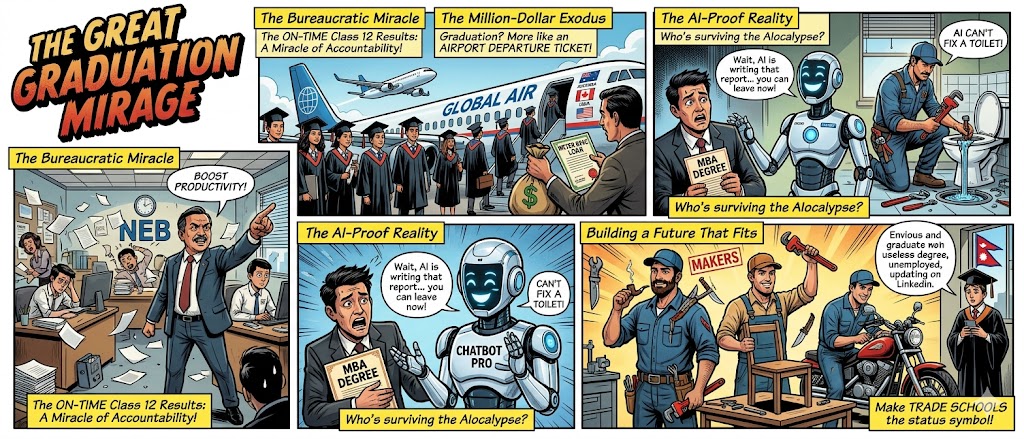
Stop the presses! Someone alert the heavens! Our National Examination Board (NEB)—an institution historically renowned for moving at the glacial pace of a bored tortoise—has actually managed to release Class 12 results on time. In this brave new "Balen Era" of accountability, it seems the fear of being roasted on social media is a far more effective motivator than, say, professional duty. It took three decades, but we finally discovered that sarkari karmacharis can actually work if the heat is turned up high enough. Miracles do happen, even in Nepal.
The Million-Dollar Exodus
So, 70% of our high schoolers have "passed." We take half a million hopefuls through the "Iron Gate" of the SEE, cull them mercilessly, and then ship the survivors through the 10+2 gauntlet. And what is the ultimate prize for this academic marathon? A one-way ticket to the airport. Statistically, 80% of these graduates are already mentally halfway to Australia or Canada, dragging roughly US$ 1 billion of their parents’ hard-earned savings—or, more accurately, their parents' soul-crushing meter-byaz loans—to foreign universities. We aren't educating a generation; we’re funding the GDP of mid-tier foreign colleges.
The Obsession with Irrelevant Testing
Can we please, for the love of all that is holy, scrap the obsession with the SEE? In the 90s, the SLC was treated like an exit visa from existence. Today, it’s just a glorified stress-test. Does anyone actually care if you were the top-scoring ten-year-old? Universities abroad look at your 10+2 transcript, not your grade-seven math project. We are burning taxpayer money and forcing parents to shell out a small fortune to private schools, all to maintain a system of constant, neurotic testing that serves no one but the tuition-center mafia.
A Plea for Sanity
It’s time to stop treating education like a permanent state of emergency. We are turning 15-year-olds into caffeine-addicted, memory-stuffing zombies. Let’s pivot. Let’s look at the "Amriki" model—where school isn't a death match—or the "German" way, where we stop pretending that every kid needs to be an accountant. If a student wants to learn how to fix a leaky pipe, wire a house, or build a bookshelf that doesn't wobble, why are we treating them like they’ve failed at life?
The AI-Proof Reality
Here’s a newsflash for the LinkedIn-obsessed: in this "evil" AI age, your expensive, generic MBA is about to be replaced by a chatbot that doesn't need lunch breaks or health insurance. AI can draft a mediocre report, but it cannot fix a clogged drain at 2 AM or paint a mural that makes a house feel like a home.
The Rise of the Makers
The upcoming AI apocalypse won't be won by the ghokantey (the rote-memorizers) who spent their youth reciting obsolete theories. The future belongs to the tinkerers, the makers, and the hands-on heroes. The plumber, the mechanic, the carpenter—these are the architects of the real world. Even Jensen Huang, the multi-billionaire messiah of Nvidia, isn't betting on the people who just copy-pasted their homework. He’s betting on those who build.
Building a Future That Fits
It is time to make trade schools the new status symbol. Let’s stop equating "manual labor" with "intellectual failure." If we don’t, we will continue to churn out an endless supply of shiny, unemployed degree-holders ready for a job market that simply does not exist.
From Paper Pushers to Problem Solvers
The future belongs to the young ones who know how to fix the machine, not to people like me who just write long, sarcastic articles about why it’s broken. Ayo Gorkhali—not with a pen, but with a toolkit. Let’s stop memorizing the manual and start building the future, one solid, non-wobbly chair at a time. Otherwise, we’re just building a bigger airport terminal for an exodus that never ends.
Jai Nepal!