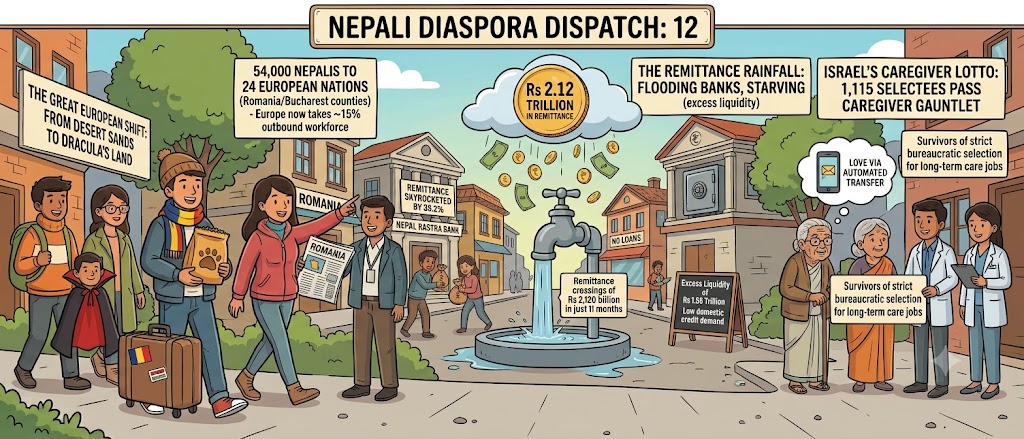
For decades, the standard recipe for Nepali upward mobility was simple: pack a bag, survive the Tribhuvan International Airport chaos, and fly to the Gulf. But according to recent data from the Department of Foreign Employment, our geographic tastes have become highly refined. In the first eleven months of this fiscal year, nearly 54,000 Nepalis packed their thermal underwear and headed straight for 24 European nations.
Indeed, Europe now swallows up nearly 15% of our outbound workforce. It seems Romania has become the new Qatar, with Nepalis officially constituting the single largest group of foreign workers in Bucharest’s surrounding county. We are swapping 50°C desert dunes for Transylvanian winters, proving that while our politicians can’t agree on a stable cabinet, our citizens have successfully negotiated a continent-wide migration upgrade.
The Remittance Rainfall: Flooding Banks, Starving Projects
We are sending home record-breaking trillions, yet the homeland has no idea what to do with them.
While our young energy builds roads in Sofia and serves coffee in Cyprus, they are sending home unprecedented mountains of cash. The Nepal Rastra Bank reported that remittance inflows skyrocketed by a mind-blowing 38.2 percent, crossing Rs 2,120 billion in just 11 months. It turns out, our greatest national export isn't tea, herbs, or pashmina—it is pure, unadulterated human effort. Yet, in a beautifully tragic comedic twist, Nepali banks are sitting on a staggering Rs 1.56 trillion in excess liquidity because local businesses are too scared to borrow.
We are practically drowning in money sent from abroad, while domestic credit demand is so flat it makes our national highways look mountainous. It is a financial masterclass: we have all the cash in the world to buy imported goods, but absolutely no confidence to build a factory at home.
Israel’s Caregiver Lotto: Finding Heaven in the Holy Land
1,115 lucky winners survive the bureaucratic gauntlet to care for the world's seniors.
In other migration triumphs, over 1,100 Nepali caregivers have successfully cleared Israel's grueling selection process for long-term care jobs. Surviving this bureaucratic hunger games is widely considered a greater achievement than passing Nepal's public service exams. While the state-sponsored lottery brings joy to over a thousand families, it highlights our ultimate economic paradox.
We export our most patient, compassionate, and skilled youth to care for the elderly across the globe, while our own grandparents are left back home, relying on automated bank transfer notifications to feel loved. Still, we choose to look at the bright side: at least a thousand more Nepalis will now have first-hand experience with actual, functioning urban infrastructure.
The Eternal Calling: "Please Invest, We Promiseland is Safe!"
Embassies beg for diaspora dollars while local bureaucracy sharpens its scissors.
Naturally, seeing this ocean of foreign currency, our diplomatic missions abroad are doing what they do best: begging. From Washington D.C. to New York, government officials are pleading with the diaspora to invest their hard-earned cash back into "the motherland," promising an "investment-friendly atmosphere". It is an optimistic pitch, especially considering that the local government just rolled out a massive tax restructuring that raises the untaxed threshold to Rs 1 million but still keeps the system delightfully complex.
We ask the diaspora for their sophisticated technology, green energy capital, and corporate wisdom, but we still make them wait in four different paper-reliant lines just to register a basic business. But hey, hope springs eternal! If we can survive the transition from the Gulf to the Schengen zone, we can survive anything.