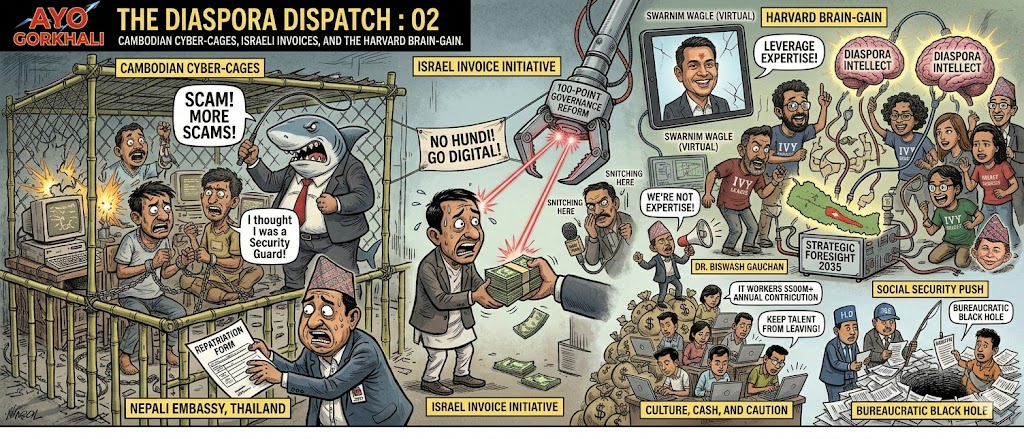
Welcome back to your weekly dose of "Selective Optimism." While the folks back home are still debating who gets the best office chair, our global Gorkhali empire is busy mapping out the next decade at Harvard and MIT. Grab your coffee, ignore the "bhag-banda" drama for a second, and let’s see where the real hustle is happening.
The "Finally, We Exist" Department
The Cambodia Cyber-Caution: The Nepali embassy in Thailand has issued a critical advisory following raids on scam centers in Phnom Penh that left hundreds of Nepalis trapped. Recruits are being lured with promises of high-paying "security guard" jobs, only to find themselves held hostage in cyber-fraud compounds where they face beatings if they fail to scam others. The embassy is currently collecting data through online forms to facilitate the repatriation of at least 277 individuals caught in this digital prison. It turns out your "dream job" abroad might just be a nightmare designed by a transnational criminal network.
The Israel Invoice Initiative: The Nepali Embassy in Tel Aviv has urged the community in Israel and Cyprus to immediately cease all informal "hundi" money transfers. This move is part of Nepal's new 100-point governance reform agenda, which includes automatic digital systems to detect suspicious financial activity and prevent money laundering. The embassy is even asking the public to report anyone facilitating these illegal transactions with evidence. It’s a bold push to ensure your hard-earned Shekels don't accidentally fund a global terror network.
Global Grit & "Brain Circulation"
Harvard’s Strategic Foresight: The inaugural "The Nepal Discourse" conference concluded at Harvard and MIT, bringing together over 50 speakers and 400 participants to debate Nepal's future in the age of AI. Finance Minister Swarnim Wagle inaugurated the event virtually, emphasizing that connecting global Nepali expertise is vital for long-term development. The central outcome is the development of "Strategic Foresight 2035," a roadmap designed to leverage diaspora intellectual power for institutional credibility and economic leapfrogging. We’re finally moving past "brain drain" and into a future where our Ivy League minds are actively designing the country’s next decade.
The Value Chain Vision: Speaking in New York on May 1st, Dr. Biswash Gauchan of IIDS warned that Nepal remains stuck in a "remittance-driven complacency trap". He argued that our national vision of prosperity cannot be achieved without innovation and moving beyond the outdated view of the diaspora as just an ATM. Instead, we need to integrate into global value chains and utilize the diaspora for trade, tourism, and research. It’s time to realize that our footprint should be global, even if our roots remain firmly in the Himalayas.
Culture, Cash, and Caution
The IT Export Engine: While traditional industries struggle, Nepal’s IT sector is now being recognized as a major economic driver, with experts highlighting its $500 million+ annual contribution. This "service-based" growth is one of the few areas where we are globally competitive, provided we can stop the talent from leaving permanently. The Harvard discourse specifically looked at how AI can reshape this workforce to ensure we aren't just passive recipients of global tech shifts.
The Social Security Push: New dialogues between the ILO and the Social Security Fund (SSF) this week are focused on creating a "coordinated approach" to protect migrant workers throughout their journey. The goal is to ensure that the social security systems in Nepal and destination countries actually talk to each other so your benefits don't disappear into a bureaucratic black hole. It’s a slow process, but for the millions working abroad, it’s a safety net that’s long overdue.
The Bottom Line: Whether it’s avoiding a digital cage in Cambodia or coding the next big AI tool in Cambridge, the Diaspora remains the true engine of Nepal's future. Keep your spirits high, your investments smart, and your remittances official.