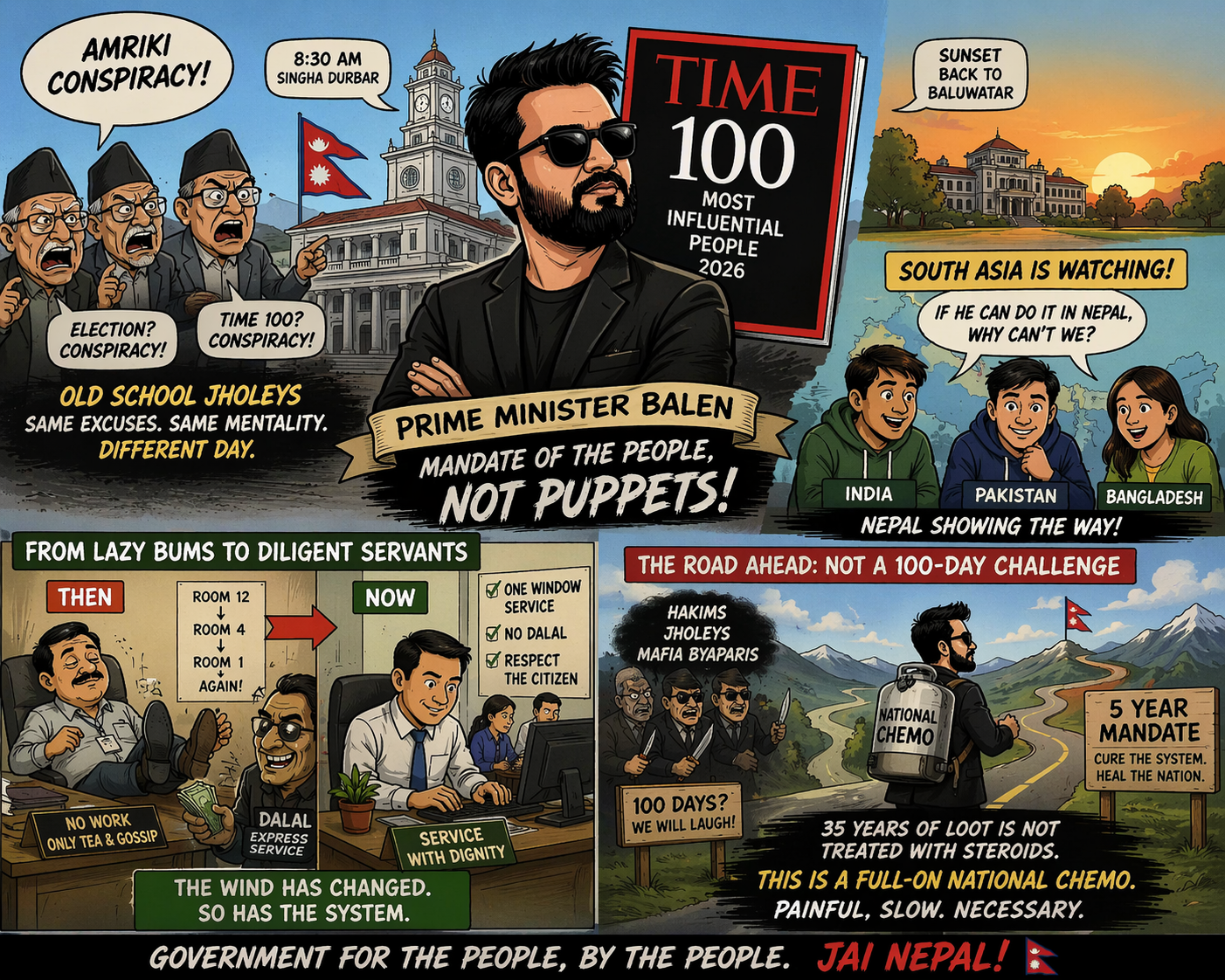
Prime Minister Balen is making headlines again, but for once, it's not about his 8:30 AM arrival at Singha Durbar or his disciplined exit back to Baluwatar after sunset. Our PM has officially landed on the 2026 TIME 100 list of the world’s most influential people. While most of us are beaming with pride, the usual gang of old-school jholeys is back to their favorite hobby: whining. To them, everything—from the election results to a magazine cover—is a shadowy "Amriki conspiracy."
The Vibe: Respect the Mandate
Let’s get one thing straight with the "Ayo Gorkhali" grit: just because the old guard spent decades leaning on foreign crutches doesn't mean every new leader is a puppet. It’s an insult to the Nepali voter to suggest otherwise. How many foreigners stood in those long lines during the election? None. The people spoke, the old structures crumbled, and the mandate is clear.
The jholeys and their Ba need to realize that their era of serving mafia byaparis over the public is reaching its expiration date. If this government continues to work for the citizens instead of the contractors, the old parties won’t see a majority for decades. The "Gorkhali" way is about loyalty to the soil, not to a party flag.
The Ground Reality: From "Lazy Bums" to Diligent Servants
It hasn't even been three weeks, yet the shift in our government offices is palpable. The same "lazy bums" who used to treat service seekers like nuisances are now at their desks on time. The labyrinth of "go to Room 12, then Room 4, then back to Room 1" is being dismantled.
In many offices, the dalals (middlemen) who used to provide "express services" for a bribe—shared with the staff—have vanished. They’ve realized the wind has changed. The arrogance of the bureaucracy is being replaced by the duty of the civil servant. This isn't just a policy change; it’s a cultural revolution.
The TIME Effect: A South Asian Wake-Up Call
Whether TIME magazine has a marketing agenda is secondary. What matters is that Balen’s inclusion is a badge of honor for a nation tired of being ignored. He wasn’t chosen for working quietly; he was chosen because he is a 35-year-old engineer, rapper, and former Mayor who is showing South Asia how to kill "VIP Culture" and systemic corruption.
The Indian media is watching. Gen Z in Pakistan and Bangladesh are taking notes. Nepal, often viewed as the "little brother" in the region, is now the one exporting a blueprint for transparency and good governance. It’s a challenge to the youth of the entire subcontinent: If a rapper in Kathmandu can fix the bureaucracy, why can’t you?
The Road Ahead: This is Not a 100-Day Challenge
We know the pushback is coming. The hakims, the jholeys, and the mafia byaparis are sharpening their knives. They will wait for the "100-day mark" to laugh and say nothing has changed.
But listen closely: this is not some 100-day fitness challenge to lose weight. This is a five-year mandate. Thirty-five years of systemic loot and the misuse of authority have left this country in a self-induced coma. You don't cure a stage-four cancer with a weekly dose of steroids or a round of antibiotics. We are going through a full-on "National Chemo" to burn out the corruption cells. It will be painful, it will be slow, but it is the only way to make Nepal come alive again.
The Bottom Line: The old school is terrified because for the first time, the government feels like it belongs to the people, not the players. We aren't looking for miracles in a month; we are looking for a backbone for the next five years.
Jai Nepal!