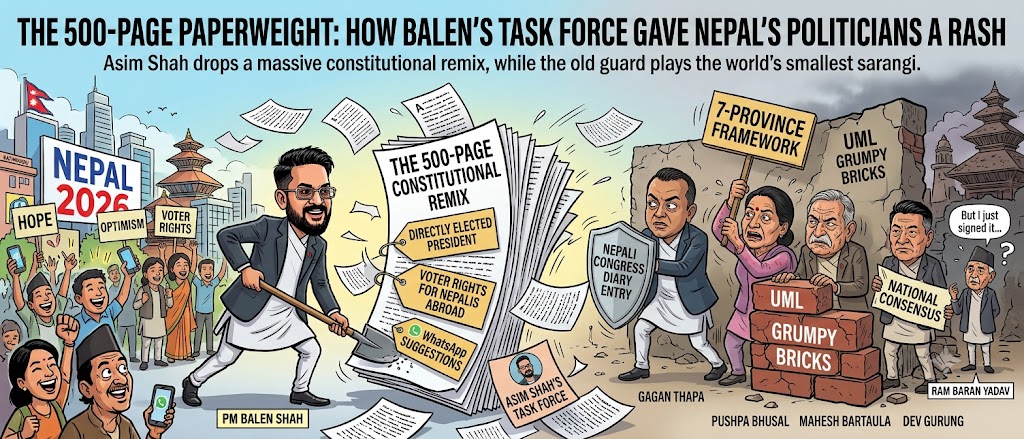
In a move that shocked absolutely no one who understands Nepali bureaucracy, a government task force has dropped a casual 500-page discussion paper on Prime Minister Balendra Shah’s desk. In a country where the 2015 Constitution is practically still shiny enough to have that "new car smell," the panel wants to surgically alter 245 out of its 308 articles.
We are talking about a total system overhaul: directly elected presidents, abolishing federalism, and downscaling the army of politicians we currently feed with taxpayer money. Naturally, our beloved opposition parties reacted with the grace of a toddler denied a chocolate bar at the supermarket checkout.
WhatsApping the Revolution and Submitting Homework Late
Task force coordinator Asim Shah proudly announced they collected over 44,000 suggestions, mostly through emails and WhatsApp. Yes, you read that right. The future blueprint of the Federal Democratic Republic of Nepal was crowded-sourced via the same app your uncle uses to send "Good Morning" graphics featuring glowing deities.
Shah’s team missed their 100-day deadline by a few days—because what is a Nepali government project without a fashionably late arrival?—but they made sure to clarify that this monster document is just a discussion paper. They haven’t recommended anything concrete, probably because taking a definitive stance in Nepal is a fast track to getting a brick thrown at your windshield.
The Ghost of Monarchies Past and Present
Meanwhile, Rastriya Prajatantra Party Chairman Rajendra Lingden crashed the party to demand the resurrection of the monarchy and a return to a Hindu state, because why look forward to the future when you can nostalgic-trip back to the 18th century? PM Balen Shah had to gently remind them that the task force just compiled a PDF, not launched a coup. It turns out the document lists 54 proposals across eight categories, including the wildly radical idea of letting Nepalis living abroad actually vote, rather than just sending back remittances to fund the political elite's luxury SUVs.
The Constitutional Experts Have a Collective Panic Attack
Cue the legal experts, who are currently weeping into their black coats. Senior advocate Tikaram Bhattarai declared the report essentially dead on arrival, arguing that because the major parties walked out, the document has the political legitimacy of a counterfeit 1,000-rupee note. Bhimarjun Acharya warned that we risk losing the current constitution altogether without a clear alternative. It’s comforting to know that our brightest legal minds view our nation's foundational law as a Jenga tower waiting for one clumsy push.
The Grumpy Old Men Boycott the Future
Why did the relevance evaporate, you ask? Because the usual suspects—Nepali Congress, CPN-UML, and the NCP—pulled out of the task force. They accused Balen’s team of trying to rewrite the universe. These are the same establishment parties who haven't successfully fixed a single pothole in Kathmandu in three decades, yet they possess the astonishing stamina required to be professionally offended by anyone else trying to do something. They complain that constitutional amendments should not be driven by the executive, which translates to: "If we didn't get to gatekeep it and take the credit, we don't want it."
Congress Writes a Diary Entry and Calls It a Framework
Not to be outdone in the sport of doing absolutely nothing useful, the Nepali Congress formed their own exclusive club led by Pushpa Bhusal to study amendments. Party President Gagan Thapa announced their official stance: the current system is flawless, the seven provinces must remain untouched, and a directly elected president is a terrible idea. Essentially, their grand vision for reform is to change absolutely nothing but maybe democratize how party leadership hoards power. Brilliant.
UML and NCP Have a Group Tantrum
Over at the CPN-UML camp, Mahesh Bartaula whined that the government is trying to dismantle the state by making local elections non-party based—God forbid citizens vote for actual humans instead of corrupt party symbols! The NCP’s Dev Gurung chimed in to grumble that national consensus was ignored. It is genuinely inspiring to see parties that hate each other suddenly unite in a beautiful, harmonious chorus of pure, unadulterated laziness.
The Audacity of Hope in a Land of Eternal Grumpiness
But fear not, citizens! Amidst this dark, circular comedy of political ego, there is a silver lining. The mere fact that a 500-page document full of radical, citizen-sourced ideas is sitting on the Prime Minister's desk means the old guard is terrified. The monopoly on power is cracking.
For the first time, the dialogue isn't being dictated solely by geriatric leaders in closed rooms, but by the sheer force of a changing era. If Nepal can survive three decades of these grumpy political dinosaurs, we can certainly survive their tantrums. The door for genuine dialogue has been kicked open, and no amount of opposition whining can fully close it again.
Jai Nepal!