Goood Morning Nepal!
1. The PMO’s Power Diet
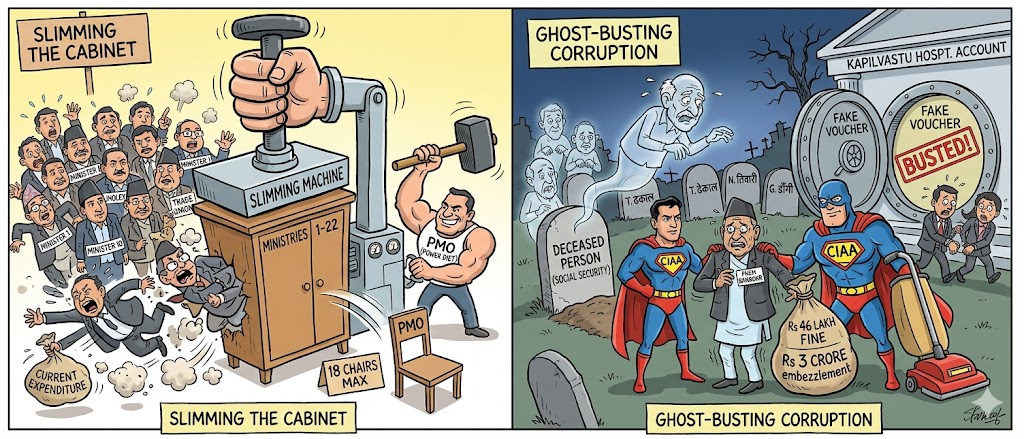
The government approved the Nepal Government Division of Work Rules, 2083, slashing the number of ministries from 22 down to 18. The Prime Minister’s Office is being made more powerful while the overall administrative structure gets leaner to reduce unnecessary current expenditure. It is a masterclass in administrative slimming—cutting the fat so there are fewer chairs for political appointees to fight over. We hope this efficiency actually results in faster service delivery and not just a more crowded hallway in the PM's office.
2. Surkhet’s Three-Crore Vanishing Act
The CIAA has filed a corruption case against three sitting Under-Secretaries and two others for allegedly embezzling nearly Rs 3 crore in revenue. The charges involve the misappropriation of income from the Surkhet Valley Town Development Committee. It takes a specific type of talent to make millions of taxpayers' rupees disappear while maintaining a government office. This move proves that the title of "Under-Secretary" does not provide a shield against the investigation of financial "creativity".
3. Ghost-Busting in Janaki Rural Municipality
A former Ward Secretary in Kailali has been sentenced to 4 years in prison and a Rs 46 lakh fine for embezzling social security funds meant for dead people. Prem Bahadur Budha was found guilty by the Special Court for withdrawing money in the names of the deceased. It is a grim irony to rob those who can no longer speak, proving that some see even the graveyard as a profit center. The court’s decision is a reminder that while the dead don't talk, their misappropriated folders eventually do.
4. Neutrality or Penalty
The Ministry of Federal Affairs and General Administration has issued a stern warning to employees regarding political involvement. Civil servants have been reminded that participating in political activities is a violation of the Civil Service Act and will lead to punishment. This comes at a time when the influence of trade unions often overshadows actual public service. We hold onto a sliver of hope that government offices might one day be filled with workers who prioritize the public over party slogans.
5. Long Life for the Grid
Dirghayu Kumar Shrestha has been assigned the responsibility of acting executive director of the Nepal Electricity Authority. The decision was made during the 1030th board meeting chaired by Energy Minister Viraj Bhakta Shrestha. Given that his name translates to "Long Life," the hope is for some much-needed longevity and stability in power management. With the energy sector always under the spotlight, he will need all the "Dirghayu" energy he can get to navigate the current political climate.
6. The Supreme Court’s Silent Treatment
The Nepal Bar Association is protesting against the Supreme Court administration for allegedly ignoring the registration of writ petitions. Lawyers claim the administration is neither registering nor properly rejecting filings, essentially leaving legal grievances in a state of limbo. It is a bold move to treat the highest temple of justice like a non-responsive help desk. Justice delayed is justice denied, but justice ignored is a whole new category of administrative "setting".
7. Resignation via Ministerial Nudge
Dr. Chandika Prasad Bhatt, the Executive Director of Nepal Oil Corporation, has resigned from his post. This follows a directive from Industry Minister Gauri Kumari Yadav, who told him to resign to "support the government" or face dismissal. It appears the "quit or be fired" approach is the new standard for administrative transitions. Perhaps the next director will focus more on the flow of oil and less on the friction of political pressure.
8. The Parliamentary Eraser
Speaker Dol Prasad Aryal has ruled that "unparliamentary" words spoken by UML leader Ram Bahadur Thapa 'Badal' be removed from the record. Phrases like "crowd of anarchists" and "those burning the country under the national flag" were deemed unfit for the official archives. It is a reminder that while our leaders may have a flair for the dramatic, the official record prefers a more sanitized version of reality. At least the history books will look more polite than the actual floor of the house.
9. The Kapilvastu Hospital Heist
Police in Kapilvastu have arrested five people, including two bank employees, for embezzling over Rs 38 lakh from Chandrauta Basic Hospital. The scheme involved using forged bank vouchers to hide the fact that government money never reached the hospital's account. When the bank's own staff are the architects of the crime, the phrase "safe as a bank" loses its meaning. This bust is a rare victory against organized economic crime that targets essential public health funds.