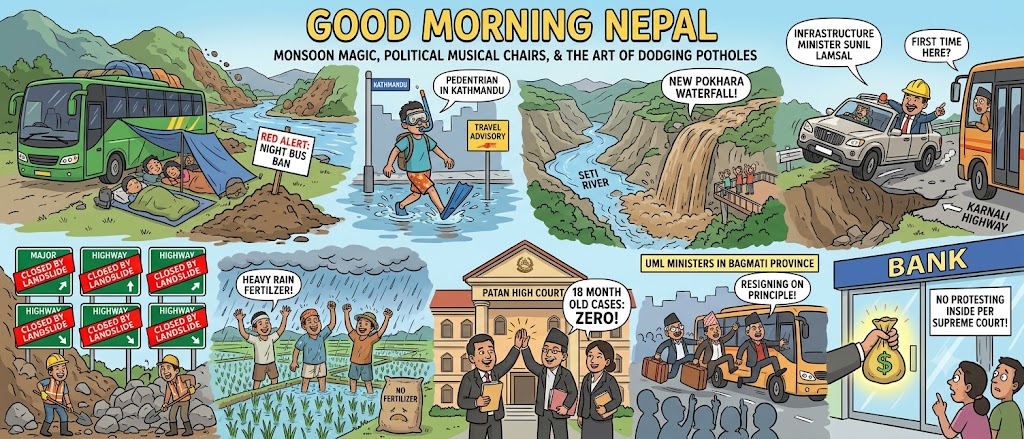
Good Morning, Nepal!
1. Midnight Curfew for Buses: 23 Districts on Red Alert
The government has banned night buses in 23 districts due to extreme flood risks, effectively deciding that if the raging rivers don't swallow you whole, the pitch-black abyss of a stranded highway definitely will, because nothing screams "world-class disaster management" quite like telling people they are perfectly safe to travel during the day, as if landslides strictly observe a 9-to-5 working schedule. Look on the bright side: thousands of travelers now get to experience an unexpected, involuntary slumber party on the side of a muddy highway with absolute strangers, but on a positive note, empowering local security committees to shut down roads early might actually keep a few hundred citizens alive to complain about the traffic tomorrow.
2. Kathmandu District Administration Issues a Polite "Don't Get Swept Away" Warning
Kathmandu authorities have issued a high-alert travel advisory, basically telling residents that stepping outside might turn their routine commute into a sudden swimming lesson, though it is truly comforting to know that while our roads turn into raging torrents, the administration is fighting back with the most powerful weapon in their arsenal: a strongly worded press release. Think of it as a free upgrade to an urban water park adventure, where navigating the city streets provides all the thrills of white-water rafting without the expensive ticket price, and the silver lining is that the meteorologists are actually tracking the weather in real-time now, giving us a fair sporting chance to stay indoors and keep our socks dry.
3. The Seti River Decides to Become a Waterfall in Pokhara
A dry landslide from months ago has finally blocked the Seti River, forcing half of its water to erupt 40 meters into the air like a dystopian fountain waiting to reclaim the neighborhood, so credit goes to nature for installing a massive, terrifying new waterfall right in the middle of the city for free since tourists pay top rupee to see the natural wonders of Pokhara. Who needs engineered dams when a pile of old dirt can reroute an entire river and create an instant, adrenaline-pumping tourist attraction overnight, especially since local authorities are actively monitoring the blockage, and the sheer resilience of the geology means the river is still finding a way to flow without completely bursting its banks yet.
4. Infrastructure Minister Discovers Highways Are Bad During Monsoons
Infrastructure Minister Sunil Lamsal went on a field trip to the Karnali Highway during peak monsoon, joyfully noting how fascinating it is to watch ordinary citizens risk their lives inside buses traversing crumbling cliffs, so we must applaud the Minister’s absolute genius for realizing that the best time to check if a road works is when it is actively dissolving into a muddy abyss. Imagine the thrill of the Minister's itinerary—spanning six rugged districts—which plays out less like an official inspection and more like a high-stakes survival reality TV show, but now that a high-ranking official has personally experienced the bone-rattling reality of the Karnali roads, there is a tiny, beautiful chance that actual budget and repairs might follow.
5. Nature Wins 6-0: Six Major Highways Completely Blocked by Landslides
Heavy rainfall has successfully paralyzed the country's transportation network by shutting down six major highways, leaving travelers with the dark realization that they are effectively trapped wherever they stand, while the Nepal Police smoothly announced the total closure of roads like Kanti Lokpath and the Arniko Highway, confirming that our national transit system is as reliable as a cardboard umbrella. It's the perfect excuse to skip out on that dreaded family gathering or awkward work meeting since you literally cannot leave your current coordinates, though heavy equipment is already stationed at high-risk zones, meaning emergency crews are standing by to clear the rubble the second the rain gods take a coffee break.
6. Fertilizer Scarcity Continues, But Rains Save the Paddy Fields
The government failed to supply chemical fertilizers yet again, leaving farmers to rely on the sky to weep enough rain to wash away the misery of state neglect, so why bother setting up a functional supply chain for agriculture when you can just rely on the annual unpredictable monsoon to do the heavy lifting for you? Against all logistical odds, the resilient farmers of Madhesh Province treated the lack of fertilizer as a minor speed bump and smashed through a 60% planting rate anyway, and a massive shipment of 137,000 tons of fertilizer is finally scheduled to arrive soon, promising to nourish the crops that sprouted purely out of the sheer willpower of Nepali farmers.
7. Patan High Court Achieves a Miracle: Zero Backlog of Old Cases
The Patan High Court has cleared all cases older than 18 months, proving that justice in Nepal can actually move faster than the geological shifts causing our landslides, meaning lawyers must be absolutely devastated to learn they can no longer drag out simple disputes for three generations to secure their retirement funds. The judges cleared a staggering mountain of over 16,000 total cases, likely setting a record for the fastest judicial sprint in modern history, and this incredible feat proves that with dedicated leadership, institutional inefficiency can be conquered, offering real hope for swift justice to thousands of citizens.
8. Tragedy in Sankhuwasabha: A Domestic Dispute Turns Fatal
A 56-year-old man in Sankhuwasabha chose a khukuri to permanently resolve a domestic dispute with his wife, proving that home is sometimes the most hazardous place to be, and it is truly remarkable how some people find it easier to swing a deadly weapon at dawn than to just sit down and have a civil conversation over a cup of tea. The local police force didn't waste a single moment, swiftly swinging into action to apprehend the suspect before breakfast time, and the rapid response of the District Police Office ensures that the perpetrator will face the full weight of the law, bringing swift accountability to a grieving community.
9. Supreme Court Rules That You Cannot Protest Inside a Bank
The Supreme Court officially ruled that disrupting banking and financial services is illegal, reminding everyone that while you can halt the entire country with protests, you must never, ever touch the rich man's money flow, making it quite shocking that the state considers the uninterrupted movement of capital to be an essential service, while basic highway safety remains an optional luxury. Activists will now have to find much more creative places to stage their protests, since the cozy, air-conditioned lobbies of commercial banks are officially off-limits, but by safeguarding financial institutions from chaos, the ruling ensures that the hard-earned money and daily economic transactions of ordinary citizens remain safe and stable.