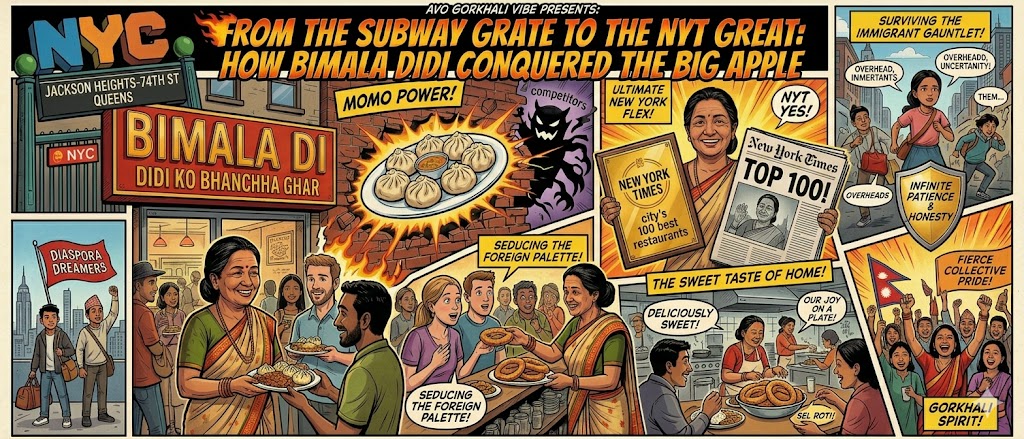
While the motherland busies itself with the infinite loop of political reshuffling and bureaucratic paperwork, the diaspora is out there quietly rewriting the global rules of engagement. It takes a unique brand of Gorkhali resilience to walk into the most competitive cities on earth and demand a seat at the table on our own terms.
Today, we look across the oceans to a crowded subway exit in New York, where standard immigrant survival has officially transformed into a masterclass of cultural dominance. This morning’s broadcast is an unapologetic toast to hard work, sharp wits, and the taste of home that refuses to be ignored.
The Ultimate New York Flex
While our brilliant leaders back home are currently playing real estate roulette with party offices and drafting the fifteenth sequel to the constitution, a real revolutionary just overthrew the culinary hierarchy of New York City. Just outside the chaotic Jackson Heights subway station in Queens, Bimala Hamal Shrestha’s humble kitchen, Nepali Bhanchha Ghar, affectionately dubbed “Bimala Didi ko Bhanchha Ghar” by the diaspora, has officially crashed the New York Times’ list of the city’s 100 best restaurants.
Let that sink in. In a metropolis teeming with Michelin stars, trust-fund bistros, and gold-leaf burgers, a small immigrant joint serving actual, unapologetic Nepali food just snatched the crown.
Seducing the Foreign Palette with Free Pastries
When Bimala Didi kicked off her culinary crusade back in 2015, the average non-Nepali New Yorker couldn't tell a momo apart from a standard dumpling, and probably thought sel roti was a typo in a bakery menu. Did she launch an aggressive corporate marketing campaign? Absolutely not. She used the time-tested, grand-maternal strategy of weaponized hospitality: feeding people complimentary, fresh, festival-style sel roti until they were hopelessly hooked. The gamble paid off.
Today, elite food critics and local hipsters alike are walking into Queens, ordering full-blown thali sets, and actively ditching their expensive silverware to eat with their hands. There is nothing quite as deeply therapeutic as watching a high-rolling Manhattan executive attempt to master the delicate thumb-flick technique of eating rice without looking like an absolute amateur.
Surviving the Immigrant Gauntlet
Of course, this shiny American Dream story didn't happen overnight; it is built on a solid foundation of brutal, character-building immigrant struggle. Bimala Didi joined the great national exodus back in 2008, trading the political instability of Kathmandu for the dizzying, unforgiving, hyper-expensive concrete jungle of New York.
Before the rave reviews and the trophy-laden Momo Competition victories, there were years of absolute uncertainty, cutthroat restaurant overheads, and the relentless pressure of surviving in one of the most demanding economies on earth. It turns out that building a cultural empire in America requires the exact same traits required to survive a microbus commute in Kathmandu: infinite patience, absolute honesty, and an iron-clad spine.
The Bitter Taste of Home, Served Daily
For the booming diaspora community occupying Jackson Heights, this recognition feels intensely personal. It is a beautiful, melancholic reminder that while thousands of young minds leave the country every single month to escape a stagnant economy, they carry the entire civilization in their spice boxes.
Bimala Didi’s kitchen has evolved far beyond a mere commercial business; it has become a sacred cultural sanctuary, a place where a plate of bhutan sukuti can instantly cure a painful wave of homesickness. As global food writers suddenly scramble to decode the rich, complex tapestry of Himalayan, Tibetan, and South Asian flavors, the diaspora can look at that prestigious New York top-100 list with fierce, collective pride.
We might be scattered across the globe, but if Bimala Didi can conquer the culinary capital of the world with a rolling pin and pure resilience, there is always hope for the Gorkhali spirit.